By Mario GonzalezGuides
How to Film & Analyze Your Padel Game
Master record padel video analysis in padel with this complete guide. Learn techniques, tips, and strategies to improve your game quickly.
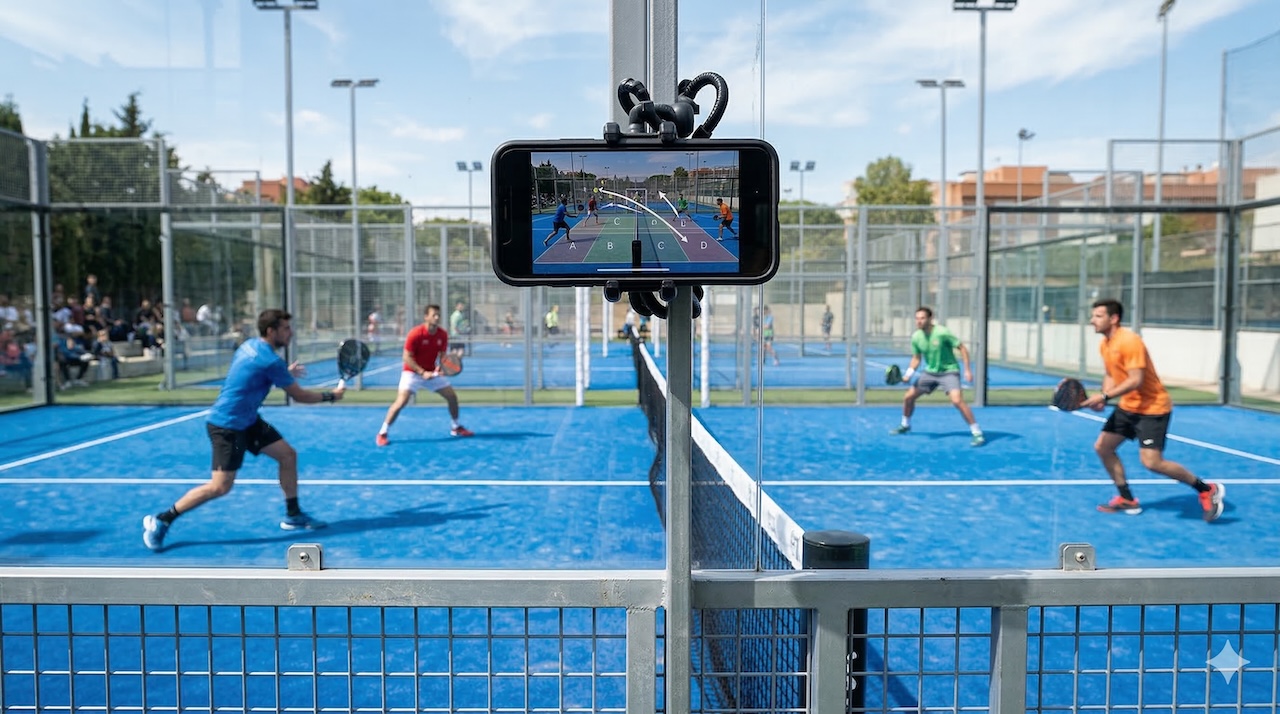
How to Film & Analyze Your Padel Game
Recording your game is one of the most powerful tools for rapid improvement in padel. You can’t see your own mistakes while playing, but a camera can.
Why Recording Your Game Matters
There’s a difference between what you think you do and what you actually do on court.
Common examples:
- You believe your defensive positioning is solid, but you’re standing too far back
- You think you attack at the right time, but you’re arriving at the net late
- You assume your serve is consistent, but it varies in height and depth
A recording reveals these patterns instantly.
Equipment You Need
You don’t need much:
- Phone or camera: Any modern smartphone works (iPhone or Android)
- Tripod or stand: $15-30 to keep the camera steady
- Location: Position the camera on one side, at net height
- Lighting: Avoid filming with the sun behind you; backlighting is better
How to Position Your Camera
Position matters. Here’s the best setup:
- Height: At net level (approximately 1.5 meters high)
- Angle: Diagonal to the court, so you capture movement of both players
- Distance: Far enough to see the whole court, close enough to see details
Avoid filming straight from the baseline; you lose perspective.
What to Record: Practice vs Match Play
Practice Sessions
- More useful for analyzing individual technique
- You can repeat the same drill multiple times
- Less chaos than a full match
Example: Record 10 consecutive serves, then analyze each one.
Full Matches
- Shows how you react under pressure
- Reveals tactical patterns (where you attack, how you defend)
- More realistic but harder to analyze in detail
Tip: Record both. Matches show the big picture; practice sessions let you work on specific details.
The Analysis Process: Step by Step
Step 1: Watch the Full Video (First Time)
Watch without overthinking. Just observe. Take mental notes of what stands out.
Step 2: Identify 3 Patterns
Don’t try to fix everything. Choose your 3 biggest errors:
- Offensive pattern (where you fail in attack)
- Defensive pattern (where you’re vulnerable)
- Physical pattern (where you lose position or balance)
Step 3: Slow-Motion Analysis
Open the video on your phone or computer with slow-motion capability. Play at 0.5x speed the moments where you make your identified mistakes.
In slow motion, you can see:
- The exact position of your racket at contact
- Your foot positioning
- Your hip and shoulder movement
Step 4: Compare with Correct Technique
Watch videos of pro players executing the same shot. Note the differences:
- Where do they position their racket?
- When do they start the movement?
- What’s their foot positioning?
Step 5: Create a Correction Plan
For each pattern, create a specific drill:
Example:
- Error identified: Your serve goes too high (ball clears the service line)
- Probable cause: Ball toss too high
- Correction: Practice 50 serves where you toss at head height, no higher
- Practice session: 10 minutes of serve drills daily for 1 week
Tools for Video Analysis
- YouTube: Upload video, play at any speed, mark important moments
- Analysis software: Free tools like Kinovea slow down video and let you draw lines on movement
- Side-by-side comparison: If your phone allows, open two videos (yours and a pro’s) side by side
Common Mistakes When Recording and Analyzing
- Recording with backlighting: Details disappear. Record with frontal or side lighting.
- Analyzing too many errors at once: Your brain can’t process 10 corrections simultaneously. Choose 3.
- Comparing yourself to pros: You’re at a different level. Compare yourself to players one level above you.
- Never watching the video again: Analyzing without action is useless. After identifying errors, train the correction.
- Not recording regularly: One recording gives point-in-time information. Record monthly to see real progress.
How to Measure Progress
Record the same type of match or session each month. Then compare videos from the previous month.
Look for:
- Did I make the same mistake 3 times or only once now?
- Is my defensive positioning more solid?
- Are my serves more consistent?
If you see improvement, move to the next error on your list.
Conclusion
Recording and analyzing your game is one of the shortcuts to rapid improvement. The best players in the world do this regularly. Don’t wait to be a pro to start.
Start this weekend: record 30 minutes of play, identify 3 errors, and create a correction plan for the week.
Published: {datetime.now().strftime(‘%Y-%m-%d’)}