By Mario GonzalezFitness
Padel Shoulder Care: Prevention and Recovery Guide
Prevent shoulder injuries in padel with targeted exercises. Learn rotator cuff care, warning signs, and recovery strategies to stay healthy.
Padel places unique demands on your shoulder. The overhead smash, the aggressive net game, and the rapid direction changes all rely heavily on rotator cuff stability. Shoulder pain is one of the most common injuries in padel players, yet it’s largely preventable with the right approach.
This guide covers prevention strategies, early warning signs, and recovery protocols to keep your shoulders healthy and strong.
Why Padel Players Face Shoulder Stress
Your shoulder is the most mobile joint in the body, which makes it powerful but vulnerable. In padel, overhead shots require explosive force combined with precision. The repetitive nature of matches—dozens of smashes and backhand slice shots—creates cumulative stress on the rotator cuff muscles.
Many padel players develop shoulder problems because they skip warm-ups, ignore early warning signs, or lack the specific strength training that padel demands. Unlike professional tennis players with structured training plans, recreational padel players often jump straight into competitive matches without proper preparation.
The rotator cuff—a group of four muscles that stabilize your shoulder—is particularly vulnerable. When these muscles are weak or fatigued, your larger shoulder muscles overcompensate, leading to inflammation and pain.
Recognizing Early Warning Signs
Catch shoulder problems early, before they become serious injuries. Watch for these signs during and after play:
During matches:
- Pain or sharp pinching sensation during overhead shots
- Loss of power in your smash (even when you’re not tired)
- Difficulty serving or hitting the ball as high as usual
- A clicking or popping sensation in the shoulder
After matches:
- Shoulder soreness that lasts more than a few hours
- Pain when reaching for objects or lifting your arm overhead
- Nighttime pain that disrupts sleep
- Stiffness that worsens the day after play
Off the court:
- Discomfort when putting on a shirt or combing your hair
- Pain when reaching behind your back
- Weakness when pushing open a heavy door
If you notice any of these, take 3-5 days off padel and focus on gentle mobility work. Most early-stage issues respond well to rest and targeted exercises.
Prevention: Build Shoulder Resilience
Prevention is always easier than recovery. These strategies reduce your injury risk significantly.
Proper Warm-Up (10-15 minutes before play)
Never skip this. A cold shoulder is an injured shoulder waiting to happen.
Arm circles: 10 forward, 10 backward. Start small circles, gradually increase range.
Shoulder blade squeezes: 15 repetitions. Squeeze your shoulder blades together, hold for 1 second, release. This activates your stabilizer muscles.
Sleeper stretch: 30 seconds each side. Lie on your side, bring your top arm down across your body, gently press your wrist toward the ground with your other hand.
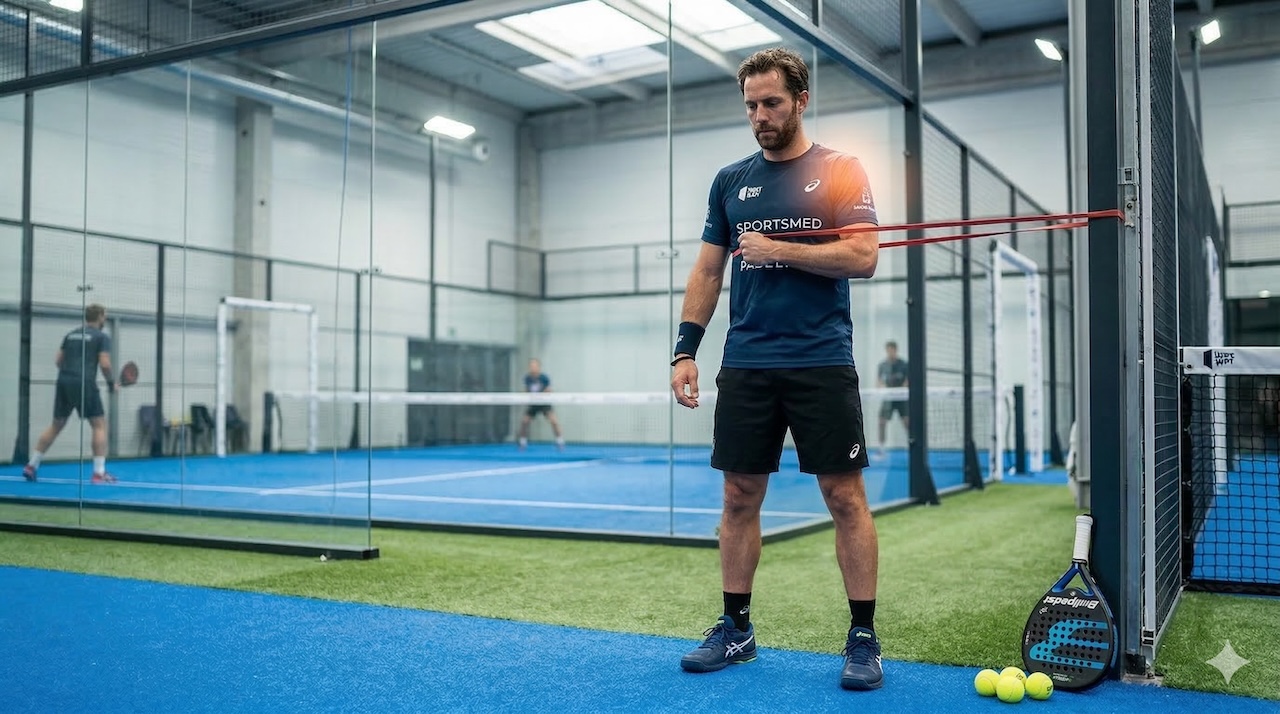
Band pull-aparts: 15 repetitions. Hold a resistance band at shoulder height with arms extended. Pull the band apart by moving your hands outward, squeezing your shoulder blades together.
Light hitting: 5 minutes of easy volleys and soft shots before competitive play. Let your shoulder adapt to movement gradually.
Off-Court Strength Training (2-3 times per week)
These exercises target the rotator cuff and stabilizer muscles that prevent injuries.
External rotation with resistance band:
- Stand holding a light band with your elbow bent at 90 degrees against your ribs
- Rotate your forearm outward 15-20 times
- Perform 2-3 sets per arm
- This strengthens the posterior rotator cuff, crucial for overhead control
Prone Y-T-W raises:
- Lie face-down on an incline bench or across a stability ball
- Perform 12 repetitions in each position: Y shape (arms overhead), T shape (arms out to sides), W shape (arms bent, hands behind head)
- 2 sets of each
- This builds the often-neglected posterior shoulder and upper back
Single-arm dumbbell rows:
- 12-15 repetitions per arm, 3 sets
- Use moderate weight (not heavy)
- This strengthens the back muscles that balance your shoulders
Planks and side planks:
- 30-45 seconds per side, 3 sets
- Core stability is essential for shoulder health
- A weak core forces your shoulder to compensate
Scapular push-ups:
- Standard push-up position
- Instead of bending elbows, move by protruding and retracting your shoulder blades
- 10-15 repetitions, 2-3 sets
- This isolates stabilizer muscles often neglected in regular training
Start with light resistance. Consistency matters far more than intensity. Many padel players get injured by jumping too quickly into heavy training.
Load Management During Play
How you distribute training stress makes a big difference.
Limit smashes in practice: If you’re doing court-wide drills, don’t perform dozens of full-power smashes. Mix in softer shots and positioning work.
Alternate shot types: Don’t spend entire sessions working on one overhead motion. Vary between serves, smashes, bandeja, and volleys to distribute load evenly.
Take rest days: Even casual padel players benefit from at least one full rest day per week. Your rotator cuff needs recovery time.
Monitor cumulative volume: Pay attention to how many matches you play per week. Two matches with recovery days between is ideal. Five matches in seven days increases injury risk significantly.
Recovery: What to Do When Shoulder Pain Appears
If you develop shoulder pain, act quickly. Most early-stage issues resolve within 2-4 weeks with proper management.
Immediate Response (First 3 Days)
Stop playing. Take 3-5 days completely off padel. Light walking or swimming are fine, but no overhead activities.
Ice application: 15 minutes, 3-4 times daily for the first 48 hours. This reduces inflammation.
Gentle range-of-motion work: Perform the sleeper stretch and shoulder blade squeezes 2-3 times daily. Move slowly—there should be no pain.
Anti-inflammatory approach: If you’re comfortable doing so, ibuprofen can help reduce inflammation in the first 48-72 hours.
Gradual Return to Activity (Days 4-14)
Mobility work: Continue stretches from your warm-up routine. Add light band work with external rotation exercises.
Test range of motion: Gradually increase your arm’s range of motion. Pain should decrease day by day.
Soft hitting: After 5-7 days, return to the court for light practice. Perform volleys and soft shots only—no smashes, no aggressive play.
Monitor pain levels: If pain worsens or plateaus after one week, consult a physical therapist or sports medicine doctor.
Return to Full Play (Week 3+)
Once you can perform pain-free volleys and soft shots:
Gradually increase intensity: Mix in moderate smashes (60% power), then full-power shots.
Match play: Start with social, lower-intensity matches before returning to competitive play.
Strengthen weaknesses: Identify what caused the injury. Was your warm-up insufficient? Did you skip strength training? Add specific training to prevent recurrence.
When to Seek Professional Help
Contact a physical therapist or sports medicine doctor if:
- Pain persists beyond 2 weeks despite rest
- You have significant loss of strength (can’t perform normal movements)
- Pain wakes you at night despite rest and ice
- Pain is accompanied by numbness or tingling in your arm
- You can’t determine the cause of the pain
A professional can diagnose the specific problem—rotator cuff strain, impingement, tendonitis, or something else—and provide targeted treatment.
Real-World Shoulder Health: A Case Study
One common pattern: a padel player takes a month off (vacation, injury, schedule), returns to the court, and immediately plays 3 competitive matches in one week. Their cold shoulder can’t handle the sudden load, and they develop pain.
The fix: After an extended break, ease back gradually. Week 1, play light social matches only. Week 2, add one competitive match. Week 3, return to your normal frequency.
Quick Reference: Prevention Checklist
- Complete 10-15 minute warm-up before every session
- Perform rotator cuff exercises 2-3 times weekly
- Take at least one complete rest day per week
- Limit matches to 2-3 per week with recovery days between
- Ice your shoulder for 15 minutes after competitive play
- Stretch for 5 minutes after every session
Related Content
For complementary training, check out these guides:
- Learn the proper smash technique to minimize shoulder stress
- Develop core strength to stabilize your entire kinetic chain
- Understand padel fitness training for overall body conditioning
Your shoulders enable everything you do in padel. Invest in their health now, and you’ll play pain-free for years to come.