By Mario GonzalezFitness
Padel Agility Drills: Ladder and Cone Exercises for Faster Footwork
Build quicker feet with these padel agility drills using a ladder and cones. Off-court exercises to improve your first step, recovery, and court coverage.
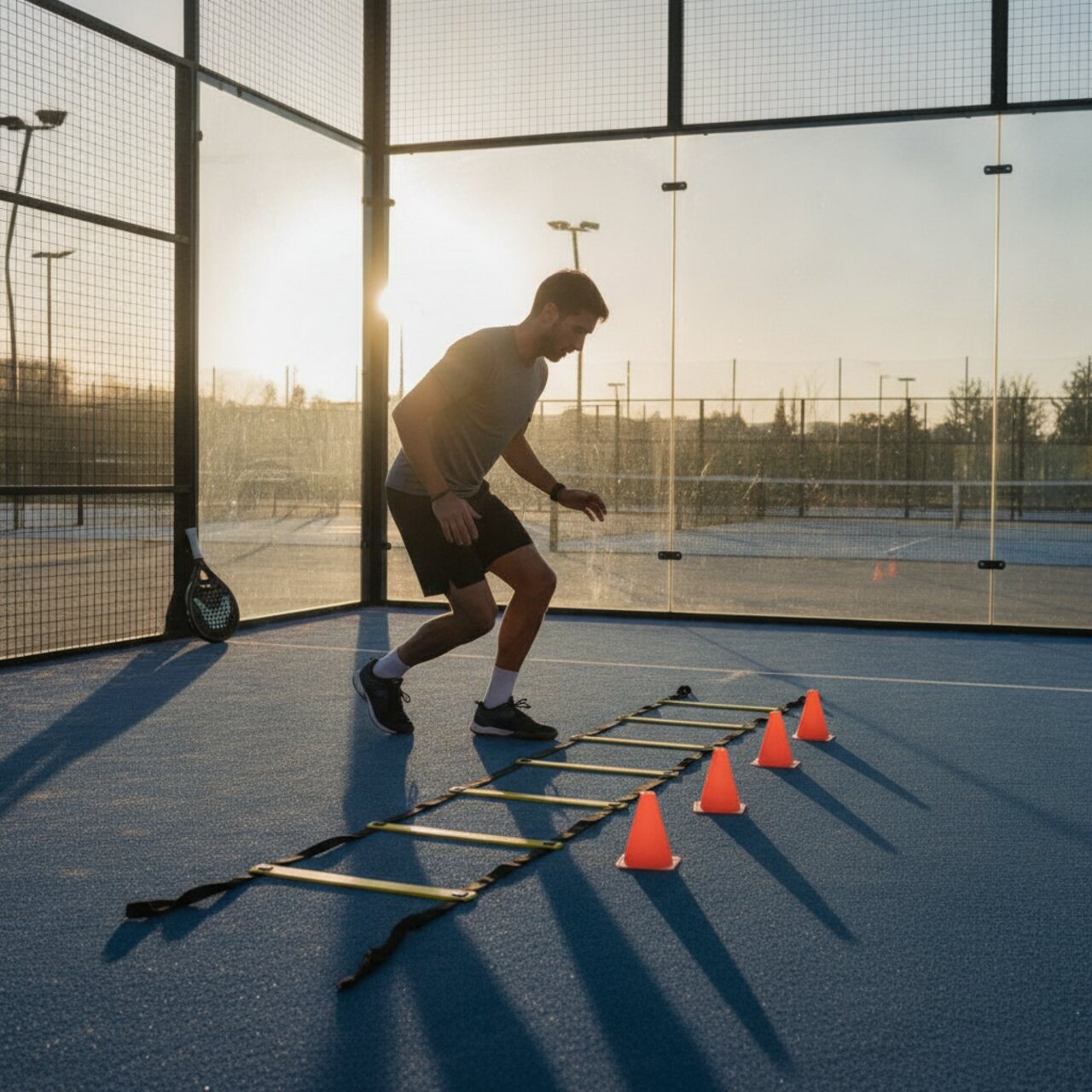
Most points in padel are lost a fraction of a second before the racket ever touches the ball. You arrive late, off balance, reaching instead of stepping, and the shot is compromised before you start it. Padel agility drills fix that gap. Ten to fifteen minutes with an agility ladder and a handful of cones, two or three times a week, sharpens the first step and the recovery step that decide whether you control the point or chase it.
The court rewards short, explosive movements more than straight-line speed. You rarely sprint more than four or five meters, but you change direction constantly, brake hard near the glass, and reset to the middle after every shot. That specific demand is what ladder and cone work trains, and it transfers directly to how you cover the court.
Why Agility Matters More Than Speed in Padel
A padel court is 20 by 10 meters, and you share half of it with a partner. There is almost no room to build top speed. What you actually do is accelerate for two or three steps, decelerate to plant for a shot, then push off in a new direction. Players who win the physical battle are the ones who reach balls in balance, not the ones who run fastest in a straight line.
Agility breaks down into three trainable pieces: the first step (reaction and acceleration), deceleration (braking under control so you can hit), and re-acceleration (recovering position after the shot). Ladder drills build foot speed and coordination. Cone drills build the change-of-direction and braking that the ladder can’t replicate. You need both.
This kind of off-court training pairs naturally with on-court court positioning fundamentals — better footwork only helps if you know where you should be moving to.
What You Need to Get Started
The equipment list is short and cheap. An agility ladder (around 4 to 6 meters, flat-rung) costs little and rolls up into a bag. Six to eight cones, or anything you can use as markers — water bottles, shoes, chalk dots. Your padel shoes, so the grip and feel match what you experience in a match. That’s it.
Train on the surface you play on when you can. Doing cone drills on artificial turf teaches your feet how the court actually grips and slides, which a gym floor won’t. If you only have access to a gym, that’s fine for the ladder; just keep the changes of direction less aggressive to protect your knees on a higher-friction surface.
Warm up first. Two to three minutes of easy jogging, leg swings, and a few build-up accelerations. Cold muscles and explosive direction changes are how ankles and calves get hurt.
Agility Ladder Drills for Padel
Run each drill for the length of the ladder, walk back to recover, and repeat. Quality beats quantity here — fast, light, quiet feet matter more than getting through more reps. If you’re stomping or looking down, slow down until the pattern is clean.
Quick Feet (One In Each Box)
Run through the ladder placing one foot in every box, staying on the balls of your feet. Pump your arms. The goal is ground contact as brief as possible, like the floor is hot. Do 4 to 6 passes. This is your baseline foot-speed drill and a good warm-up for the rest.
Two Feet In Each Box
Both feet touch each box before moving forward — right, left, then advance. It forces faster turnover and tighter coordination. Start slow to get the rhythm, then build speed across 4 to 6 passes. When you can do it fast without looking at your feet, you’ve built the coordination that lets you adjust your steps mid-rally.
Lateral In-and-Out
Stand sideways to the ladder. Step both feet into a box, then both feet out the other side, moving down the ladder laterally. This trains the sideways shuffle you use constantly when covering down the line or sliding across to help your partner. Do 3 to 4 passes each direction so both lead legs get worked.
Icky Shuffle
The classic lateral pattern: two feet in, one foot out, moving diagonally down the ladder. It looks awkward at first and clicks within a session or two. This one mirrors the staggered footwork of recovering toward the middle after a wide shot. Aim for 4 passes once the pattern feels natural.
Cone Drills for Change of Direction
Cones train what matters most for padel: stopping and starting in new directions. Place them to mimic real court movement rather than running random patterns. Rest fully between reps — these are short and intense, and tired reps build sloppy braking habits, not sharp ones.
The 5-10-5 (Pro Agility)
Set three cones in a line, five meters apart. Start at the middle cone. Sprint five meters to one side and touch the cone, change direction and sprint ten meters to the far cone and touch, then drive back five meters through the middle. This is the gold-standard change-of-direction drill, and it maps almost perfectly onto sprinting wide to cover a ball and recovering across the court. Do 4 to 6 reps with full rest between each.
T-Drill
Arrange four cones in a T: one at the base, one five meters ahead, and two more five meters to each side of the top cone. Sprint forward to the top, shuffle laterally to one side cone, shuffle all the way across to the other, shuffle back to the middle, then backpedal to the start. It blends forward acceleration, lateral shuffling, and backpedaling — exactly the mix you use moving from the net to a lob and back. Run 3 to 5 reps.
Star Drill for Reactive Movement
Place four or five cones around you in a rough semicircle, two to three meters out. Start in an athletic stance in the center. Explode to a cone, touch it, and return to the center before pushing off to the next one. Vary the order so you’re not running a memorized pattern. If you have a training partner, have them call out which cone to hit — that adds the reaction element that makes it most game-like. Do 3 to 4 sets of 6 to 8 touches.
First-Step Reaction Drill
Stand at a central cone in your ready position. Have a partner point left or right (or drop a ball to one side). React and explode to a cone two meters away, plant, and recover to center. No partner? Use a simple rule — alternate sides but vary the timing yourself. This isolates the single most valuable movement in padel: the explosive first step from a stationary ready position. Do 8 to 12 reactions per set, 2 to 3 sets.
Building These Drills Into Your Week
Two to three sessions a week is enough to see a difference within a month. Keep each session short — 15 to 20 minutes of focused work beats 45 minutes of tired, sloppy reps. A simple session looks like this: warm up, run two ladder drills (about 8 minutes), run two cone drills (about 8 minutes), done.
Rotate which drills you use so your feet keep adapting instead of memorizing one pattern. One day lean on lateral ladder work and the 5-10-5; the next session do the icky shuffle and the T-drill. Progress by adding speed, then adding reaction (a partner’s call), then shortening rest — in that order.
Slot agility work on non-match days or as part of your warm-up routine, not after an exhausting session when your form falls apart. If you’re already following a structured padel fitness program, agility fits best on your lighter days alongside a proper stretching routine to keep your ankles and hips mobile.
What to Expect and Common Mistakes
Give it three to four weeks of consistent work before judging results. The first thing you’ll notice isn’t measurable on a stopwatch — it’s that you arrive at balls a half-step earlier and hit in balance more often. That balance is what turns a defensive scramble into a controlled shot.
The most common mistake is going too fast too soon. Sloppy, heavy footwork trained at high speed just reinforces bad movement. Build the pattern slowly, then add pace. The second mistake is skipping the deceleration. Plenty of players love the sprinting half of a drill and float through the braking and recovery half — but braking under control is exactly what protects your knees and lets you hit. Train the stop as hard as you train the start.
Watch your posture, too. Stay low in an athletic stance with your chest up, not hunched over looking at your feet. And don’t neglect strength — agility drills sharpen movement you already have, but core and leg strength give you the power behind that first step and the stability to stop hard without rolling an ankle.
Put a ladder and a few cones in your bag, give the work fifteen focused minutes a few times a week, and the payoff shows up where it counts: getting to one more ball, in balance, when the point is still yours to win.