By Mario GonzalezFitness
Core Exercises for Padel: Build Rotational Power and Court Stability
Core exercises for padel that build the rotational power behind your smash and the stability that keeps you balanced on every shot. Train it right.
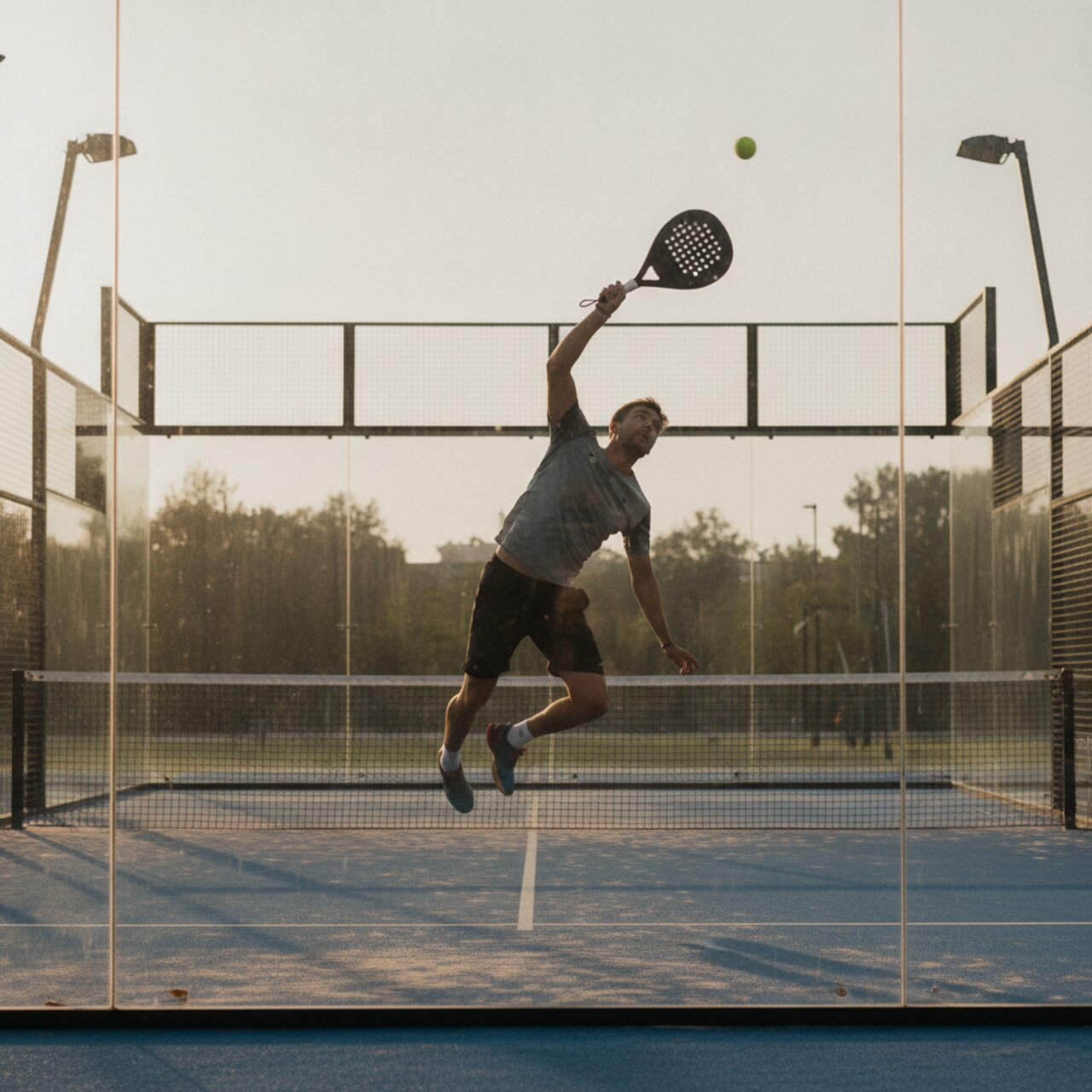
Almost every shot in padel starts from your trunk. The smash, the bandeja, the víbora, even a punchy crosscourt volley all draw their power from the rotation between your hips and shoulders, not from your arm. That is why core exercises for padel matter more than most players realize: a stronger, faster-rotating midsection adds pace to your attacking shots and keeps you balanced when you reach wide for a defensive ball.
The mistake most amateurs make is training the core for looks instead of for the sport. Endless crunches build a midsection that flexes forward, but padel almost never asks you to bend forward against resistance. It asks you to rotate, to resist rotation, and to stay stiff while your arms swing fast. Train those three qualities and you will feel the difference in your overheads within a few weeks.
Why Rotational Power Wins Points
Watch a pro hit a smash in slow motion. The kinetic chain runs from the ground up: the legs push, the hips open, the torso uncoils, and only at the last moment does the arm whip through. The core is the link that transfers force from the large muscles of the legs and hips into the racket. A weak or slow trunk leaks that energy, which is why two players with identical arm strength can produce wildly different smash speeds.
This sequence has a name in sports science: the proximal-to-distal pattern. You generate force with the big, slow segments first, then accelerate the small, fast segments last. Your core sits in the middle of that chain. When it fires hard and at the right moment, your smash carries pace and your bandeja drops with bite. When it lags, you compensate with the arm, which both reduces power and overloads the shoulder over time. If shoulder pain is already part of your padel life, the long-term fix often lives in the trunk, not the joint itself. The padel shoulder care guide covers that connection in more detail.
Rotational power also protects you on defense. When you stretch for a ball off the back glass, a stiff, controlled core lets you load and counter instead of just flailing the ball back into the middle of the court.
The Three Core Qualities Padel Demands
Before listing exercises, understand what you are actually training. Padel rewards three distinct core abilities, and a good program touches all of them.
Rotational power is the ability to turn your trunk explosively. This is what feeds your smash and your serve.
Anti-rotation strength is the ability to resist twisting. When you plant to hit a fast volley, your core has to stay rigid so your arm has a stable platform. Players who lack this get pushed off balance and spray easy balls.
Anti-extension and bracing is the ability to keep your spine stable while your shoulders rotate overhead. This is the quality that protects your lower back during repeated smashes and bandejas.
Train only rotation and you become powerful but unstable. Train only planks and you become solid but slow. The exercises below cover the full range.
Rotational Power Exercises
Medicine Ball Rotational Throw
This is the single most sport-specific core exercise for padel. Stand side-on to a wall, about a metre away, holding a 3-4 kg medicine ball. Load by rotating away from the wall, coiling your hips and shoulders, then explosively uncoil and throw the ball into the wall at chest height. Catch the rebound and reset.
The cue that matters: drive from the back hip, not the arms. Your hands just hold the ball; the rotation comes from your trunk turning over a stable lower body. Do 3 sets of 6-8 throws per side, resting fully between sets. Quality and speed beat volume here. If the throws slow down, stop the set.
Cable or Band Wood Chop
Anchor a resistance band at shoulder height. Standing side-on, grab the handle with both hands and pull it down and across your body toward the opposite hip, rotating through the trunk. The movement mimics the diagonal force path of a smash. Keep your arms relatively straight so the work stays in the core, not the shoulders. Do 3 sets of 10 per side, moving with control on the way back.
Standing Band Rotation
Anchor the band at chest height and stand side-on with arms extended in front of you. Rotate away from the anchor in one smooth, fast motion, then return slowly. Unlike the wood chop, this keeps tension on the horizontal plane that matches your volley and flat smash. Three sets of 8-10 per side.
Anti-Rotation and Stability Exercises
Pallof Press
Anchor a band at chest height, stand side-on, and hold the handle at your sternum with both hands. Press it straight out in front of you and hold for 3-5 seconds while the band tries to twist you toward the anchor. Your job is to refuse. This is the cleanest way to train the anti-rotation strength that keeps you stable on quick volleys. Do 3 sets of 8 presses per side with a deliberate pause on each rep.
Plank with Shoulder Tap
A standard plank is fine, but adding a shoulder tap turns it into an anti-rotation drill. Hold a strong plank position and slowly lift one hand to tap the opposite shoulder without letting your hips rock. The instability forces your trunk to resist rotation, exactly the demand of planting for a shot. Aim for 3 sets of 10 taps per side.
Suitcase Carry
Hold a single dumbbell or kettlebell in one hand and walk 20-30 metres while keeping your torso perfectly upright. The load tries to pull you sideways; your core resists. It is simple, it carries over directly to on-court balance, and it doubles as grip and shoulder work. Do 3-4 walks per side.
Building a Core Routine That Fits Padel
Two focused sessions per week is enough for most recreational players. Each session should include one rotational power exercise, one anti-rotation exercise, and one bracing movement. Keep the rotational work explosive and low-rep, and keep the stability work slow and controlled.
A sample 20-minute session: medicine ball throws, then Pallof presses, then plank shoulder taps, then suitcase carries. Rest fully between the power exercises so every throw is fast. This is not conditioning work, so resist the urge to rush it into a sweaty circuit. Speed and quality are the point.
Place these sessions on non-match days or after a match rather than before. Rotational power training is taxing on the nervous system, and you want to be fresh, not pre-fatigued, when you play. Pair the routine with a proper stretching routine for padel to keep the hips and thoracic spine mobile enough to actually rotate, and treat your recovery between matches as part of the training, not an afterthought.
What to Expect
Give it four to six weeks of consistent work before judging results. The first thing most players notice is not raw power but timing: the smash starts to feel like it comes from the body rather than the arm, and the shot lands with less effort. Pace follows once the new movement pattern is grooved.
You should also feel steadier on wide defensive balls and fast exchanges at the net. That stability is the anti-rotation work paying off, and it often shows up before the power gains do.
Strength alone will not fix a flawed technique. If your smash mechanics are off, more core power just lets you hit a bad shot harder. Build the engine and the movement together. Once the rotational base is there, work on translating it into shots with the back wall smash and refine your overall court movement through the fundamentals in the complete beginner’s guide. Track which matches feel sharper and which feel flat, and you will quickly see how much of your padel runs through the middle of your body.