By Mario GonzalezTechnique
Padel Footwork and the Split Step: How to Move Inside the Point
Padel footwork decides more points than technique does. The split step, the five in-point movement patterns, recovery position and four drills to fix it.
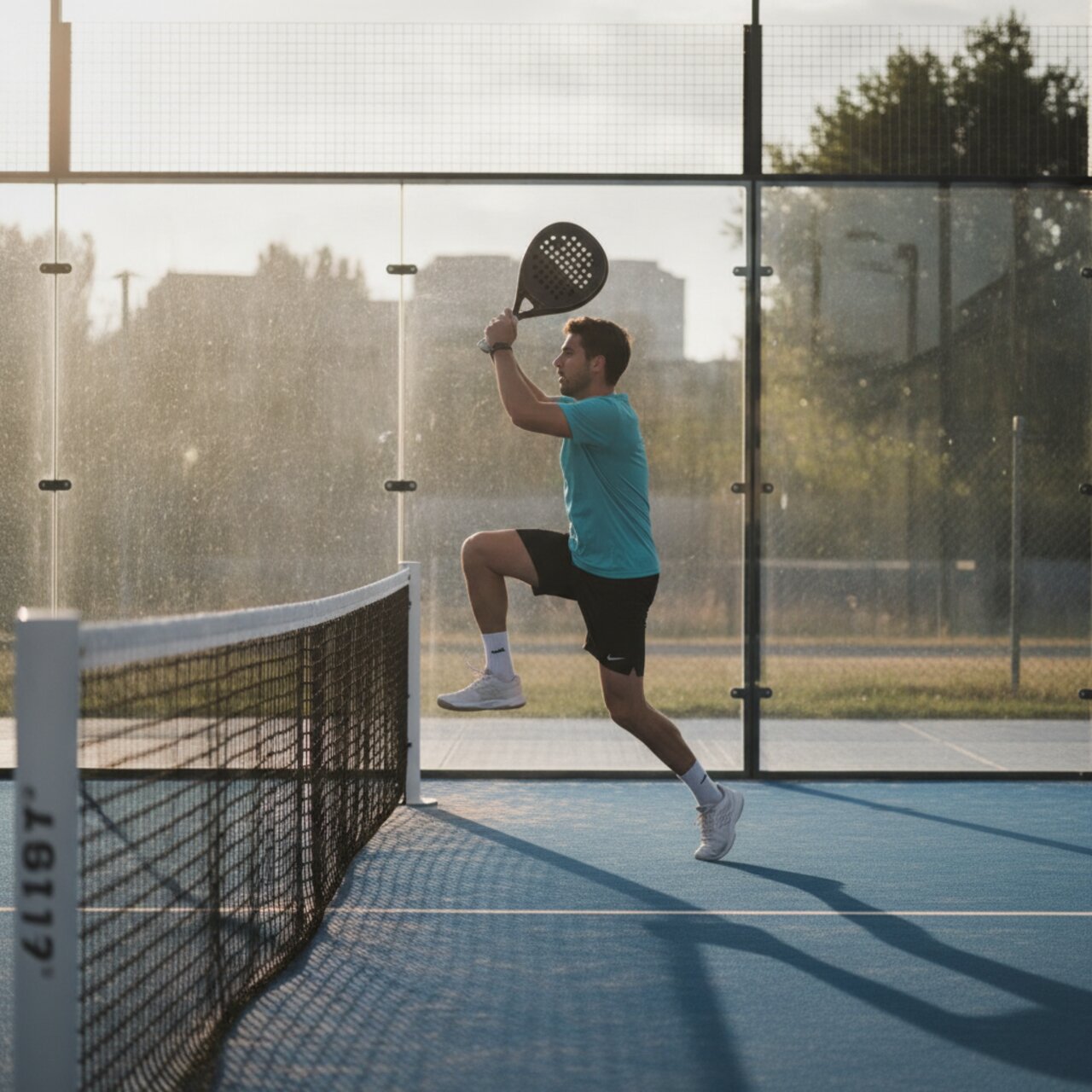
Watch a club match from behind the glass and count the errors that come from a bad swing. Then count the ones that come from a player arriving late, arriving flat, or arriving with their weight on the wrong foot. The second number is bigger, and it is not close. Padel footwork is the cheapest available improvement for most players, and it starts with the split step.
This is not ladder work. Agility drills with a ladder and cones build the engine — your capacity to change direction. What follows is steering: when to move, in which pattern, and where to stop.
Why the Split Step Decides the First Half-Metre
Standing still is not a neutral state. A player planted on flat feet has to shift their weight before they can push off, and that shift costs somewhere around a quarter of a second. On a padel court a quarter of a second is roughly a metre and a half of ball travel, which is the whole difference between a comfortable forehand volley and a block off your hip.
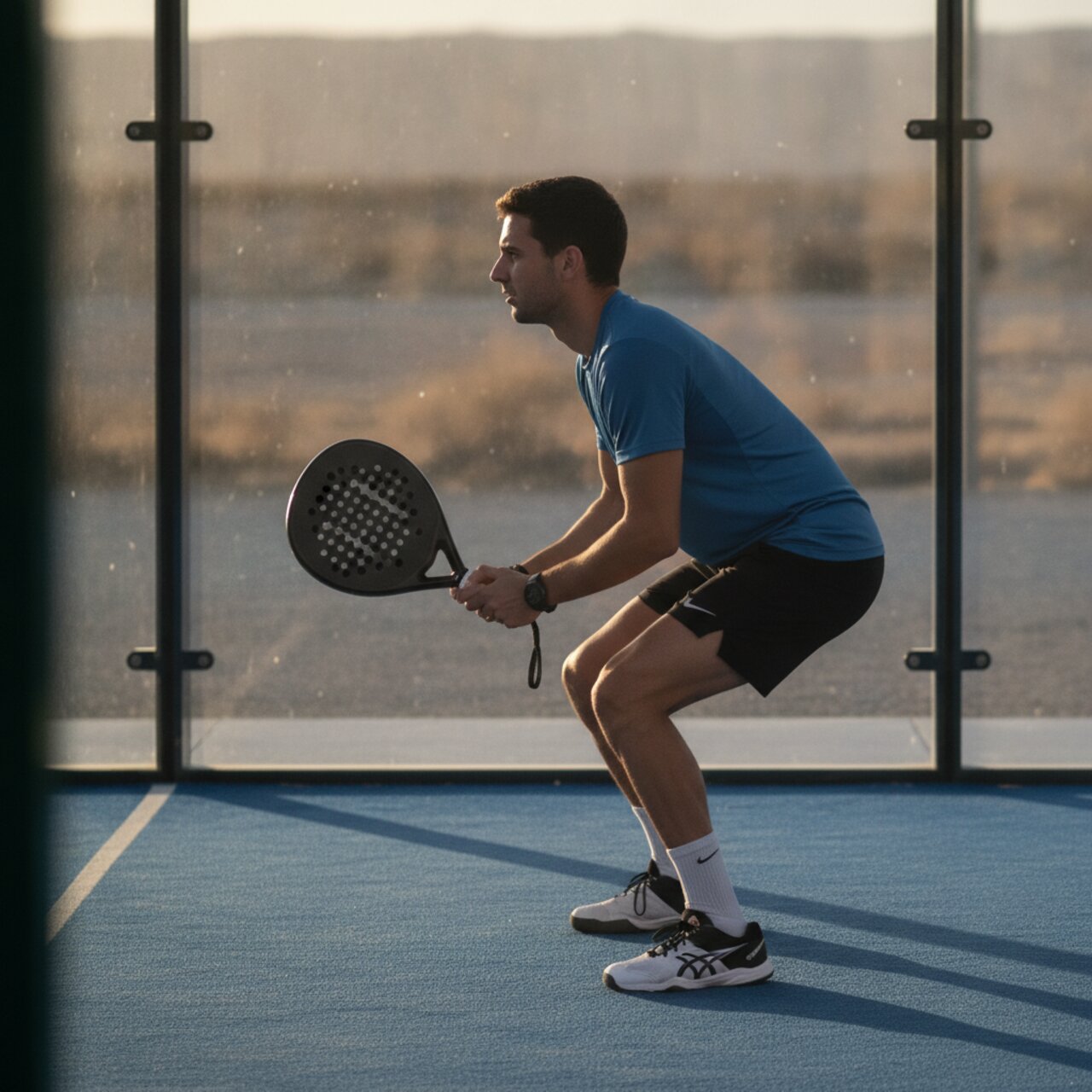
The split step deletes the shift. It is a small hop, timed so you land with feet apart and knees soft at the moment your opponent strikes the ball. Landing pre-loads the legs, and a pre-loaded leg can push in any direction immediately. You are not guessing where the ball is going. You are making yourself equally ready for every option.
Padel’s version is smaller than tennis’s. You want two to five centimetres of air, not a visible jump. Points here happen at close quarters, and a big hop leaves you hanging in the air while a volley arrives at your chest. Think of it as a bounce rather than a leap.
Timing It Properly
The single most common fault is splitting too late — hopping after the opponent hits, which is worse than not splitting at all because you are airborne when you should already be moving.
Take your cue from the racket, not the ball. When your opponent’s racket starts forward from its highest or furthest-back point, you go up. Their contact and your landing happen together. Say it as a two-count in your head during practice: their racket goes, I go down.
Do it on every opponent contact. Their serve, their return, their volley, their bandeja, the drive you are certain will go out. There are perhaps eight to twelve of these moments in an average rally, so the habit has to be automatic rather than decided.
Where to Split From
At the net, split from roughly two metres back rather than glued to the tape. That extra metre lets you take the lob that would otherwise pass over you, and you lose almost nothing on the volley because you are moving forward into it as you land.
From the back, split from about a metre and a half inside the back glass. Any deeper and you have no room to let a fast ball come off the wall to you.
The Five Padel Footwork Patterns That Cover Almost Everything
Nearly every movement in a padel point is one of five patterns. Learn which one belongs to which ball and the choice stops costing you time.
1. The Side Shuffle
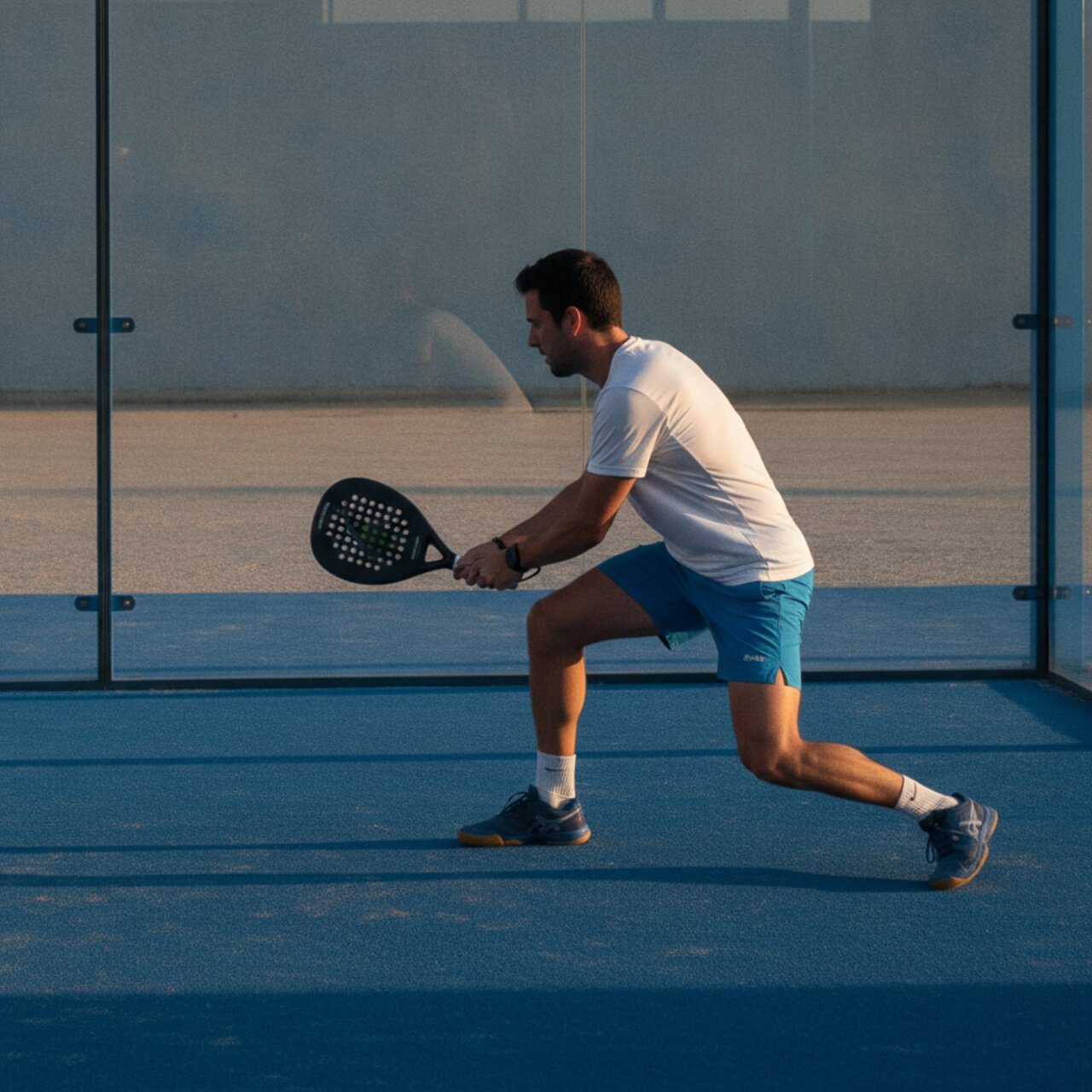
For anything within two steps of where you stand. Push off the outside foot, bring the feet toward each other without touching, keep your chest square to the net. Your racket stays up in front of you the whole way.
The rule that matters: never cross your feet at the net. Crossed feet cannot change direction, and the ball that comes back at your body catches you locked.
2. The Crossover Step
For balls wider than two shuffle steps. Open the hip toward the ball, cross the far foot over, then get back into an open stance for the shot. One crossover covers about the distance of three shuffles, so it is what you use for a ball driven down the tramline.
Shuffling all the way to a wide ball is a classic club error. You look busy and you arrive late.
3. The Drop Step and Turn
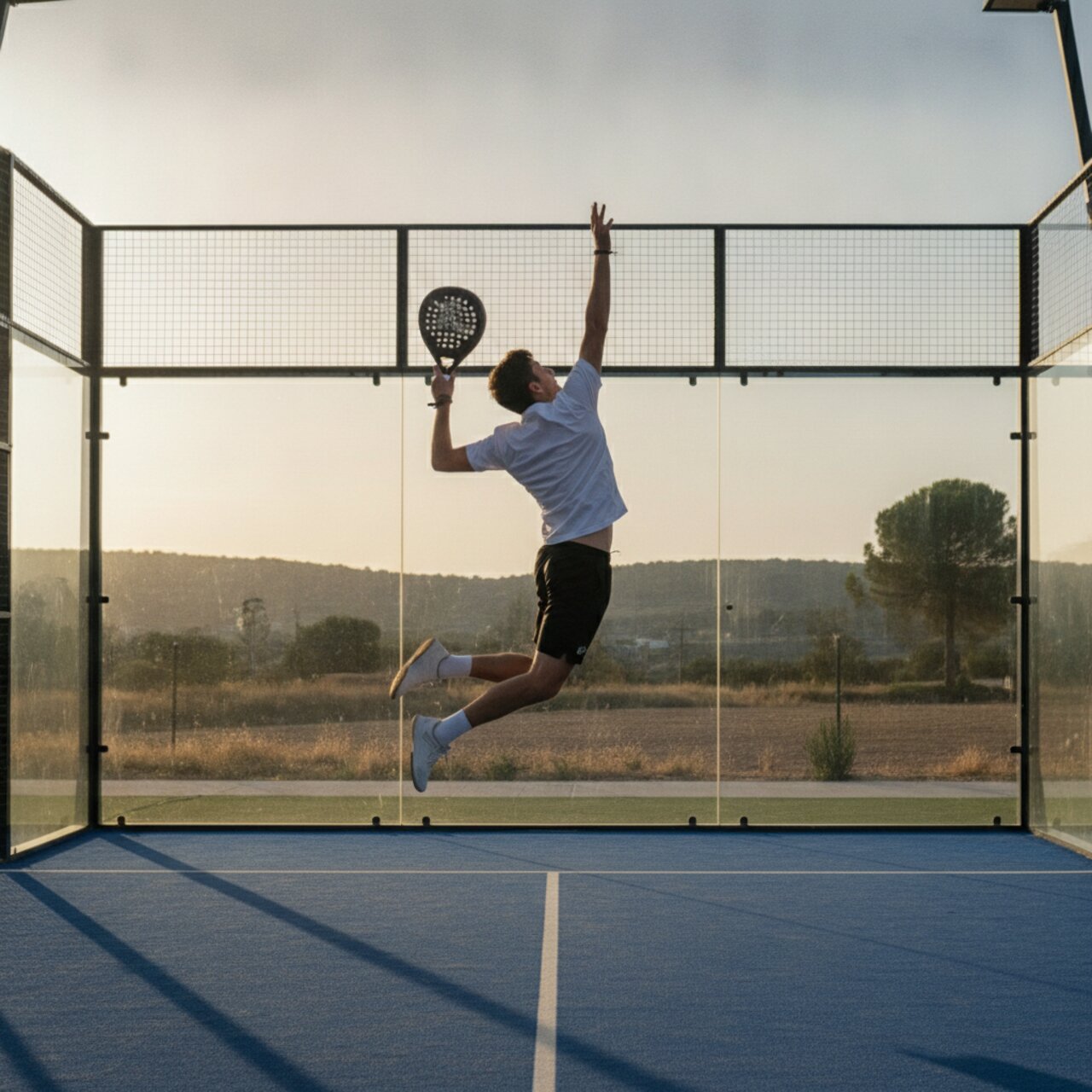
For anything over your head. Instead of backpedalling, open your hips by dropping the outside foot back roughly 45 degrees, then run facing the side wall while tracking the ball over your shoulder.
Backpedalling is slower, and it is how players end up on the floor. It also keeps your weight moving backwards through contact, which is why so many defensive overheads land in the net. Turning lets you get past the ball, plant, and hit forwards. This is the pattern that decides whether you can play the corners or merely survive them.
4. Get Past It, Then Come Into It
The pattern that has no equivalent in tennis. A ball heading for the back glass needs you behind where it will end up, not on top of it. Retreat past the bounce line, let the ball come off the wall, then step forwards into contact with your weight travelling toward the net.
Players who move backwards until the ball reaches them end up cramped against the glass with the ball on their toes. The retreat should be early and slightly too far; the correction comes forwards, which is the easy direction to correct in.
5. The Closing Diagonal
For short balls: drop shots, chiquitas, anything dying near the net. Step across with the outside foot on a diagonal toward the ball, take contact in front, then push back off that same foot toward your position.
The push back is the part people forget. Anyone who has hit a good drop shot and then watched their opponent’s counter-drop bounce twice in the space they just vacated has skipped the recovery.
Recovery Position: Where You Stop Matters More Than How Fast You Move
Most players recover to the same square metre out of habit. Your recovery position should be dictated by the ball you just hit.
Hit a lob down the left tramline and the opponents’ best reply comes back on that same diagonal, so you recover a step to the left of centre — not to the middle. The principle is to bisect the range of angles available to your opponent, and every shot you hit changes that range.
Your partner’s position changes it too. The pair moves as a unit, so if your partner is pulled wide to the right, your recovery point slides right with them. Understanding the three court zones and how a pair moves through them is what makes recovery a decision rather than a reflex.
Common Mistakes and How to Fix Them
Admiring your own shot. Standing still to watch where the ball lands costs you the split step for the reply. Fix it by treating recovery as the last phase of the stroke: swing, and the first step back is part of the same movement.
Heavy heels at the net. If your heels touch the ground while waiting, you cannot react to a fast volley at your feet. Play a whole game consciously keeping your heels a few millimetres off the floor and you will notice the difference in the third point.
Splitting only when you feel threatened. Players split before a smash and stand flat before an opponent’s soft chiquita. The soft ball is exactly the one you want to attack, and you cannot attack from flat feet. Split on everything.
Taking small steps on the way to the ball and big steps at the end. Reverse it. Big steps early cover ground; small adjusting steps at the end put you at the right distance from contact. Getting close to the ball early and then shuffling is what produces balanced hitting.
Turning your back completely on a lob. Turning is correct; turning so far that you lose sight of the ball is not. Keep the ball in your peripheral vision over the shoulder, which is what allows you to hit a bandeja instead of a scramble.
Four Drills That Fix Padel Footwork
Racket-cue splits. Stand at the net while a partner stands opposite with a ball and racket. They make a normal swing, sometimes hitting, sometimes not. You split on the racket movement every time. Three sets of twenty repetitions. It sounds trivial and it retrains the cue faster than anything else.
The freeze call. Play out points normally. At random moments your partner or coach shouts “freeze” the instant an opponent makes contact. You stop dead and check three things: were your feet apart, were your knees bent, was your racket up. Honest answers here are uncomfortable for the first session.
Turn-and-run lobs. A feeder lobs deep to your side. You must turn with a drop step, run facing the side wall, let the ball come off the glass, and hit forwards. Ten balls per side. Any repetition where you backpedal does not count.
Two-cone recovery. Place cones a metre either side of your net position. A feeder alternates volleys to your forehand and backhand at an unpredictable rhythm. You must touch your recovery point between every ball. Two sets of sixty seconds, which will feel considerably longer than a minute.
Where Footwork Meets Tactics
Good movement buys time, and time is what lets you choose. A player who arrives balanced can pick between a drive and a lob; a player who arrives late has whatever shot the ball leaves them. That is why footwork sits underneath every tactical decision, including when to attack and when to defend and how confidently you approach the net.
Give it three weeks of deliberate attention. Split on every ball, choose the pattern that matches the distance, and recover to the position your own shot created. Nothing about your swing has to change for your error count to drop.