By Mario Gonzalez
The smash por tres in padel: how to send the ball out over the side wall
Learn how to execute the smash por tres in padel: step-by-step technique, when to use it, common mistakes, and the best videos to master this spectacular shot.
The smash por tres: the shot that closes the point (and leaves everyone speechless)
If there’s one shot in padel that generates “oohs” and “aahs” on the court, it’s the smash por tres. That ball that goes flying out over the side wall while your opponent can only watch it pass. It’s spectacular, yes, but it’s also one of the most effective shots for closing points.
The good news? It’s not as hard as it looks. You just need to understand the mechanics, the timing, and the right direction.
What is the smash por tres?
It’s a smash (overhead) that’s aimed toward the side wall of the court, with enough power and angle so that the ball goes out over the three-meter glass wall. That’s where the name comes from: “por tres” (over three meters).
When you execute it well, the ball bounces on the ground, hits the side wall, and shoots out over the top. Your opponent can’t do anything. Point won.
When to use it
- When you have a high, centered lob: this is the ideal situation.
- To close the point definitively: if you’ve been pressuring with bandejas and volleys.
- When your opponents are glued to the back: they have little margin to reach it.
- To vary your aerial game: if you only play bandejas, opponents get used to it.
How to execute it step by step
1. Position and preparation
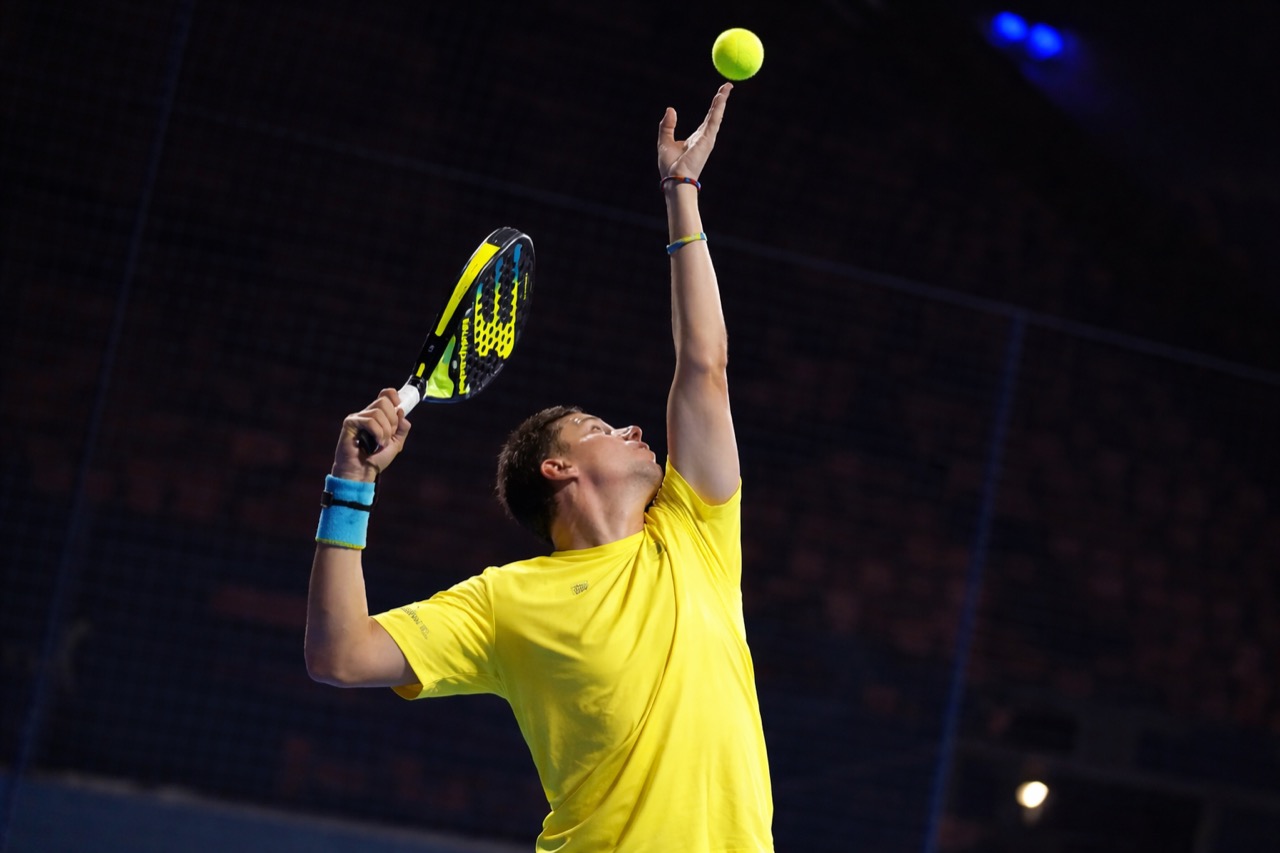
- Position yourself sideways, like you’re about to throw a stone. Non-dominant shoulder pointing toward where you want to send the ball.
- Paddle back and up, with your elbow high. Your non-dominant arm points at the ball.
- Legs spread, weight on your back leg.
2. The strike
- Movement from top to bottom and forward, with rotation of hips and shoulders.
- Impact the ball at the highest point you can reach.
- Look for topspin effect so the ball bounces high after hitting the wall.
- Aim toward the side wall, with an angle that makes the ball bounce on the ground first.
3. The direction
- Forehand: aim toward your opponent’s left side wall (cross-court).
- Backhand (less common): toward the right side wall.
- The important thing is that the ball bounces on the ground before reaching the wall.
4. After the shot
- Maintain your position at the net.
- Coordinate with your partner to cover the gaps.
Common mistakes
| Mistake | Consequence | Solution |
|---|---|---|
| Hitting flat without spin | The ball doesn’t rise after the bounce and doesn’t go out | Look for topspin effect |
| Aiming too close to the wall | The ball hits the glass directly | Make sure it bounces on the ground first |
| Bad body position | You lose power and control | Position yourself sideways, not facing forward |
| Hitting the ball too low | The ball goes into the net or without power | Wait for the highest point |
| Not calculating the angle | The ball hits the wall but doesn’t go out | Practice the direction |
Advantages
- Point practically won if executed well
- Spectacular shot that puts psychological pressure on opponents
- Essential variation for unpredictable aerial play
- Works at all levels
- Forces opponents to hit more difficult lobs
Risks
- If you miss, you give up the net
- Requires good positioning
- Don’t overuse it - sometimes a bandeja is a better option
- Depends on the lob - you need a high ball with time
Recommended videos
- 🎥 Lamperti teaches Ariana Sánchez how to hit it out over three - Nox Padel
- 🎥 Smash x3: 6 technical keys - Mejora Tu Padel
- 🎥 Learn with Paquito Navarro - Hit it out over three - World Padel Tour
- 🎥 How I hit the smash to bring it to my court - Paquito Navarro
- 🎥 3 steps to hit a flat smash x3 with Asier Gago - Raphael Cuesta
Pro tip
The smash por tres isn’t just about hitting it hard. What really matters is the angle and the spin. A well-directed smash with topspin goes out more easily than a cannonball without control.