
By Mario GonzalezGuides
How to Track Your Padel Matches the Easy Way
Most players forget their padel results within a week. Here is how to track your padel matches the easy way and turn every game into stats you can use.
Most padel players can tell you who they played last week. Ask for the score, or who they played three weeks ago, and it’s gone. If you actually want to improve, that lost history is the problem, and the fix is simple: track your padel matches. A short record of every game turns a blur of Tuesday nights into something you can learn from.
Tracking sounds like admin nobody has time for. Done right it takes about ten seconds after a match, and it pays you back with a clear picture of your game, your best partners, and where you stand in your group.
Why tracking your matches is worth it
You can’t improve what you don’t measure. Without a record you’re guessing about whether you’re getting better, which partners suit you, and who you actually beat.
A few weeks of tracked matches answers questions memory can’t. Your real win rate, not the flattering version you carry in your head. Which partner you win most with. Whether you quietly fold against one particular pair. How long your current streak is. And the question every group argues about, who is really the best player in your group.
The answers often surprise you. You might be sure your usual partner is your best one, then see from the data that you’re 8 wins and 2 losses with someone you rarely pick. That’s not a feeling you can trust from memory, but it’s obvious once the matches are written down.
There’s a motivation side too. Watching a streak build, or a win rate climb month over month, makes you want to play more and play sharper. A logged match counts for something. An unlogged one is forgotten by Friday.
What to actually record
Keep it minimal or you won’t stick with it. Three things are non-negotiable: the score, who played on both teams, and the date.
That alone unlocks win rate, head-to-head records, and partner stats. If you want more detail, add the club or court, which side you played on, and a one-line note on how it went. Useful, but optional. Don’t let chasing the perfect record kill the habit. Score, players, date, done.
The methods, from worst to best
Memory. Free and useless. You remember your best wins and little else, and every stat you quote will be wrong in your favor.
A notes app or WhatsApp. A step up, because at least it’s written down. But a wall of text gives you no win rate, no head-to-head, no partner breakdown. You’ve stored the data without any way to use it.
A spreadsheet. This genuinely works, and plenty of serious groups run one. The catch is friction. One person ends up chasing everyone for scores and typing them in by hand, and most group spreadsheets are abandoned inside a month.
An app. The easy way. Everyone logs their own matches in seconds and the stats build themselves. No chasing, no formulas, and nobody stuck as the group’s unpaid data-entry clerk.
How to track a padel match in seconds
The habit that makes tracking stick is logging right after you play, while you’re still catching your breath by the net. Open the app, tap in the score, confirm the players, save. Ten seconds, before you’ve packed your bag.
With Padellog the players are usually already in your recent list, so you tap instead of type. The score goes in set by set, the date fills itself in, and the match is saved on the spot. Do that every time and the record builds itself, with no separate “I’ll enter it later” session that you both know you’ll skip.
Turn the data into something useful
A logged match on its own is just a record. The value is what a few weeks of them become.
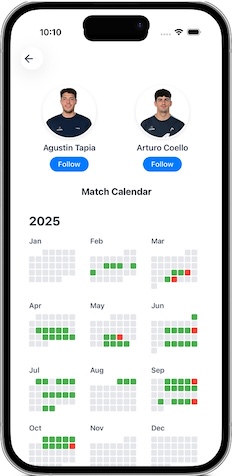
Win rate shows your real form instead of your mood. Streaks show momentum. Head-to-head records settle your rivalries with a number. Best-pair stats reveal which partnership actually delivers, which is often the surprise of the season. A match calendar shows how often you really play, usually less than you’d guess. None of this asks anything of you beyond the ten-second log, because the app does the maths.
It compounds, too. Your logged matches feed a group leaderboard and a season table, so tracking your own games quietly builds the thing that answers “who’s best” for the whole group, and gives everyone a reason to book the next court.
What two weeks of tracking looks like
Log every match for two weeks and the picture sharpens fast. Say you play three times a week, twelve matches in all. From memory you’d call it “a decent fortnight.” The record says something more specific: 7 wins, 5 losses, a 58% win rate.
Look closer and it gets useful. You won 4 of your 5 matches alongside one particular partner and lost 3 of 4 with another. You’re riding a 3-match winning streak. Against the pair you “always struggle with,” you’re actually 2 and 1. None of that was knowable on Sunday night from memory, and all of it changes who you ask to play next week and how you set up when you do.
The mistakes that ruin your data
Two habits quietly wreck a record. The first is only logging the wins. It feels good and makes your win rate a lie. Log the losses too, especially the ugly ones, because a record you’ve curated tells you nothing.
The second is waiting. “I’ll add it tonight” turns into three unlogged matches you can no longer remember the scores of. Log it on the court or don’t count on logging it at all. Skipping the “meaningless” casual games is the same mistake in a smaller coat: those games are half your season.
Make it a habit
The only hard part of tracking is consistency, and one rule fixes it: log the match before you leave the court. Not that night, not “later.” Later never comes.
Get your regular group doing the same and the habit reinforces itself, because everyone’s matches feed the same leaderboard and nobody wants to be the missing gap in the table. Within a month you’ll have something no amount of memory can give you, an honest and complete picture of your padel.
Start tracking your padel matches today, keep it to ten seconds a game, and let the stats do the rest. If it isn’t on Padellog, it doesn’t count.