By Mario GonzalezStrategy
Winning From the Back of the Court in Padel: Defence That Buys the Net
Winning from the back of the court in padel is about earning the net, not hitting winners. Holding patterns, the three-ball build and four drills that fix it.
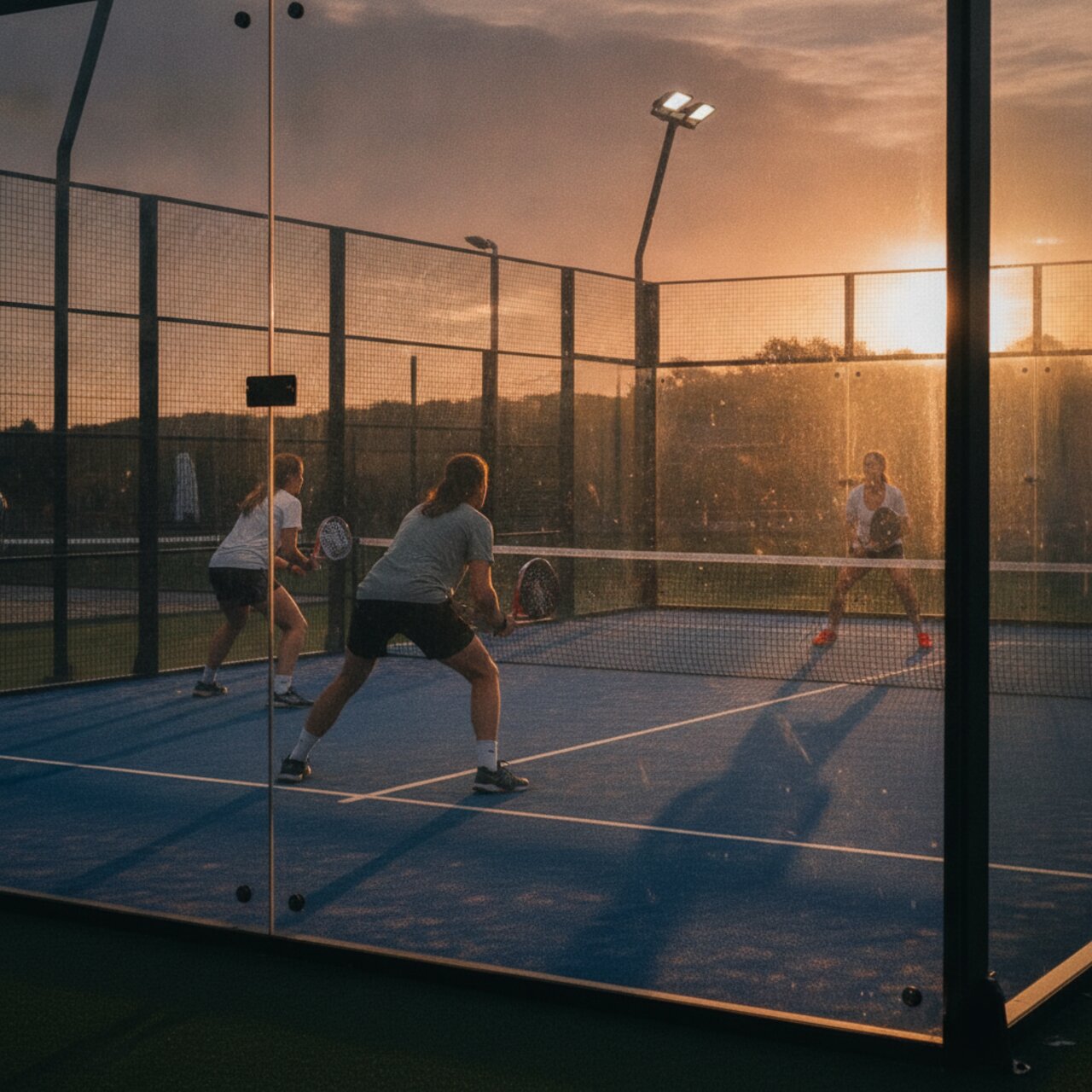
Take a pen to your next match and mark, point by point, which pair was standing at the net when the rally ended. At club level the answer lands somewhere around two thirds of the time, and it barely moves with the level of play. That single number explains why winning from the back of the court in padel has almost nothing to do with hitting winners from deep, and everything to do with how you get out of there.
The back of the court is not a losing position. It is a waiting position with rules. Players who understand those rules win a third of the points they play from deep and convert most of the rest into a net entry. Players who do not spend their afternoons hitting brilliant, doomed passing shots into a volleyer’s chest.
What Winning From the Back of the Court Actually Means
Change the objective. When you are behind the service line with two opponents at the net, your goal for that rally is not to win the point. It is to make the net pair’s position untenable, so that either they hand you the net or they make the error themselves.
That reframing changes every shot choice you make. A ball that keeps you alive and forces a defensive overhead is a good shot even though it wins nothing. A ball that goes for the winner and comes back at your feet is a bad shot even though it looked ambitious. Judge your shots from deep on what position they produce two shots later, not on whether they drew applause.
Three outcomes count as a win from the back: they miss, they lob short and you punish it, or their overhead lands soft enough that you can walk in. Everything you hit should be aimed at one of those three.
Where to Stand Before Anything Happens
Most club players defend from the wrong metre. They sit on or just behind the service line, which is the one part of the court where the ball is always at their shins and the glass is too far away to help.
Defend from about a metre to a metre and a half inside the back glass. From there a driven ball reaches you at a comfortable height after the wall, and you have room to step forward into it rather than being pinned. If you are stranded closer to the service line when the opponent strikes, back up first and hit second.
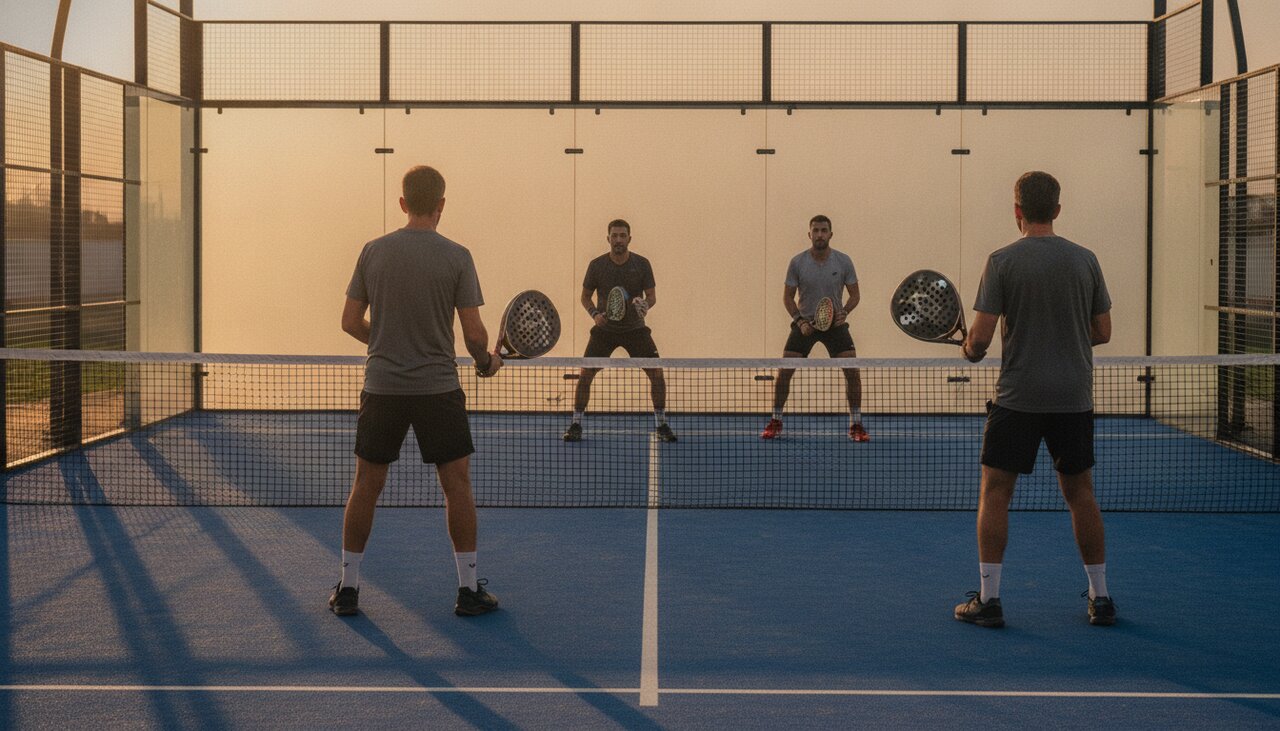
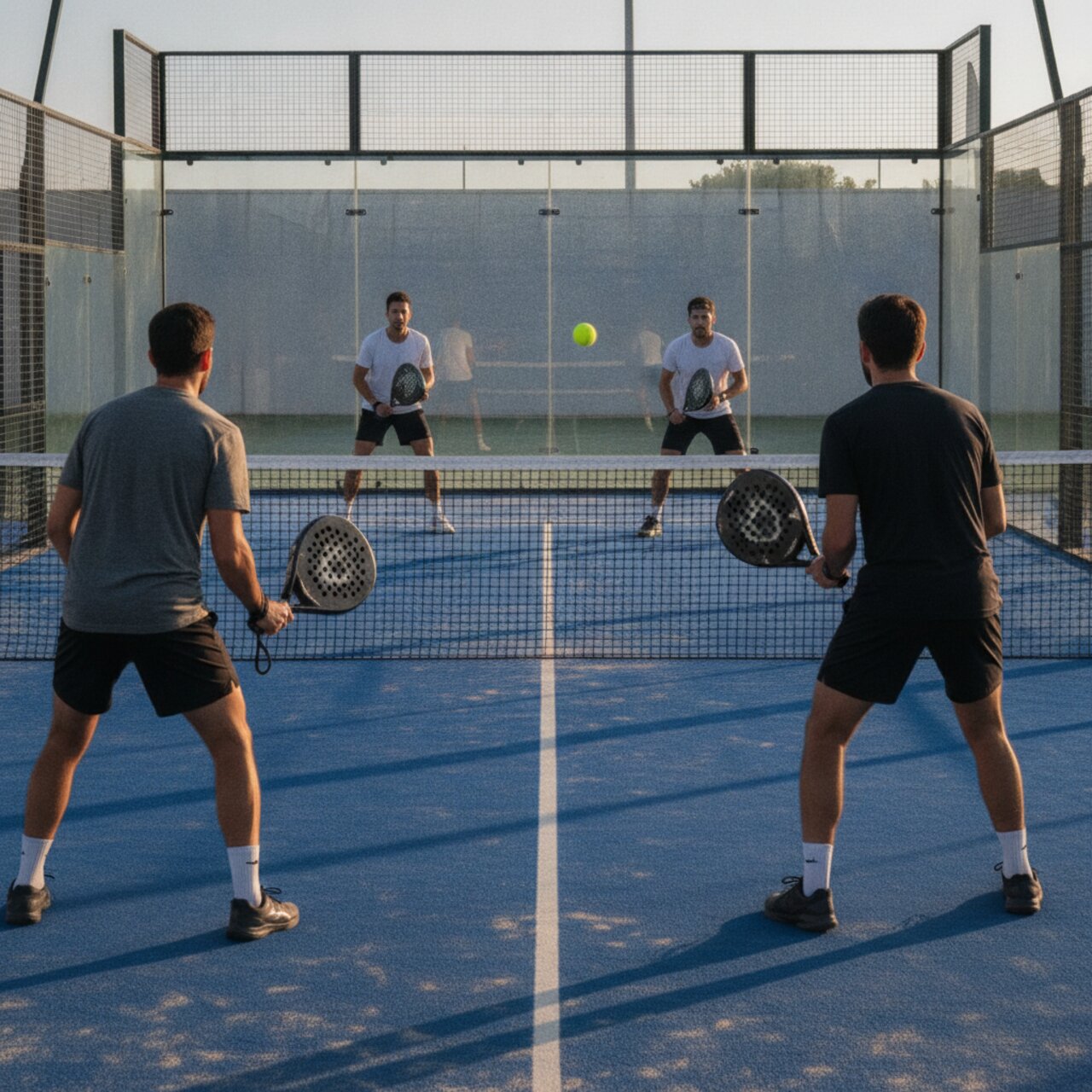
Your partner mirrors you. Both defenders sit at roughly the same depth, about three metres apart, shifting together toward whichever side the ball is on. If the ball is with the opponent on your left, both of you slide left by a metre or so and leave the far tramline open. That tramline is a low-percentage target from the net anyway, and the middle is not.
Holding Position: The Discipline Nobody Practises
The most expensive mistake in back-court play is not a bad shot. It is going forward behind a ball that did not earn it.
You go in when one of three things is true: your lob has landed in the back couple of metres of their court, their overhead is clearly defensive, or their reply floats above net height. Anything else and you stay. A mediocre lob that lands around their service line buys you nothing, and following it means you arrive in the middle of the court just as a smash arrives at your ankles.
Hold and you stay in the point. Rush and you end it. When you decide to hold, hold properly: get back to your defensive depth, split, and be ready to defend two, three, four more balls without frustration. Long defensive phases are where matches turn, because the net pair is doing the physically harder job of hitting overheads and eventually one of them shortens.
The rule I give players is blunt. If you cannot say out loud why you are moving forward, you are not moving forward. Read when to attack versus when to defend for the fuller version of that read.
The Three-Ball Build From Deep
Points are rarely won with one shot from the back. They are built over three, and each ball has a different job.
Ball one: neutralise
Kill the pace and buy yourself position. This is usually a deep lob or, when the ball comes hard to your feet, a low block crosscourt that dies short. Do not try to be clever with a ball that arrives at 80 km/h with you off balance. Height and depth beat direction here.
The defensive lob is the workhorse of this phase, and its only non-negotiable is depth: land it in the last two metres. A high lob that drops on the service line is a gift.
Ball two: displace
Now move somebody. A lob over the backhand shoulder of the player at the net forces them to turn, run and hit an overhead they would rather not hit. A low crosscourt drive to the same shoulder makes them volley down and up. The chiquita — a slow, low ball that lands at their feet — does the same job from the other direction.
Displacement is not about which shot. It is about making one specific opponent move twice in a row, because the second movement is where the technique falls apart.
Ball three: enter
The reward for the first two balls is a short overhead or a floating volley. Take it forward. Move through the ball toward the net rather than hitting from where you stand, and finish inside the service line so the next volley is yours. The mechanics of that transition are covered in the counter-attack guide.
If ball three does not arrive, restart at ball one. There is no shame in three consecutive lobs, and there is a lot of shame in a passing shot attempted from three metres behind the service line.
Pick a Target and Keep Picking It
Deep defence goes much better when you stop spreading your shots evenly across two opponents.
Find the weaker overhead in the first three games and lob that shoulder all afternoon. Almost every club pair has one player whose bandeja is a real shot and one whose bandeja is a hopeful swat. Feed the second one.
Beyond that, three targets repay attention. The player who just hit the previous ball, because they are recovering and moving. The gap between them when they have drifted apart, which is a low, flat ball straight down the middle. And the player who has crossed to cover the middle, whose own tramline is now standing empty.
Repetition is the point. Four lobs to the same shoulder in a row is not predictable, it is pressure, and around the fourth one the reply usually shortens.
Defending as a Pair, Not as Two Individuals
Two defenders who move independently leave a hole down the middle and both drift toward their own tramlines. Move as a unit, connected by an imaginary three-metre rope, exactly as you would at the net. The same principle drives the whole court, and the three court zones guide explains why.
Settle the middle ball before it happens. The simplest workable rule from deep: whoever is on the side the ball came from takes it, and if it is dead central, the player with the forehand takes it. Agree it once, then stop negotiating mid-rally.
Talk in short words. Mine, yours, out, up. The most useful call from the back is up, meaning your partner should lob rather than drive, and it is worth having because the player closest to the ball often cannot see how well the net pair is positioned.
Above all, go in together or not at all. One defender advancing alone is the single easiest situation to attack in padel, because the smash simply goes behind them.
Common Mistakes and How to Fix Them
Driving hard at a volleyer’s body. From behind the service line a flat drive gives an opponent two metres from the net roughly half a second to react. They do not need to be good, only to hold the racket still. Fix: use the drive only when you are inside the service line or the ball sits above your waist.
Lobbing without depth. Height without depth is a smash invitation. Fix: aim to hit the back glass on the full and accept that a few will be long. Two long lobs a set means your depth is right.
Standing on the service line. No man’s land gives you the ball at shin height and no wall help. Fix: retreat to a metre inside the glass on every reset.
Following a bad lob to the net. Covered above, and worth repeating because it costs more points than any technical fault. Fix: watch your own lob land before you decide.
Giving up on the phase. Players sigh, half-defend the fourth ball and hand over the point. Fix: count the balls you defend rather than the points you lose. Six-ball defences that end in a lucky error are exactly how you win these matches.
Four Drills for Back-Court Play
Lob depth ladder. Two players at the net feed volleys, one at the back lobs only. Score a point for every lob landing in the last two metres, minus one for anything landing shorter than the service line. Play to ten. Most club players start negative.
Ten-ball hold. Two at the net attack, one or two at the back must survive ten consecutive balls without going forward and without hitting a winner. It teaches your legs what a long defensive phase feels like and removes the itch to end things early.
Same-shoulder repetition. The back pair may only lob to one designated shoulder for a whole basket. Boring, effective, and a fair simulation of what a good pair does to you.
Earn the net. Standard four-player point, but the defending pair may only come forward after a lob that lands behind the service line. If they come in early, they lose the point automatically regardless of what happens next. Play eight points, swap.
Defence in padel is not a fallback for players who cannot attack. It is a phase with its own patterns, its own footwork and its own way of scoring, and it is the phase where most club matches are actually decided. Get comfortable at the back, learn to build the three balls, and the net stops being something you rush toward and starts being something you are given. Work on net approaches next, so that when the invitation arrives you are ready to accept it.