By Mario GonzalezStrategy
Poaching in Padel: When to Cross for Your Partner's Ball
Poaching in padel wins points and quietly loses them. When crossing for your partner's ball pays off, when it opens the court, and how to rotate behind.
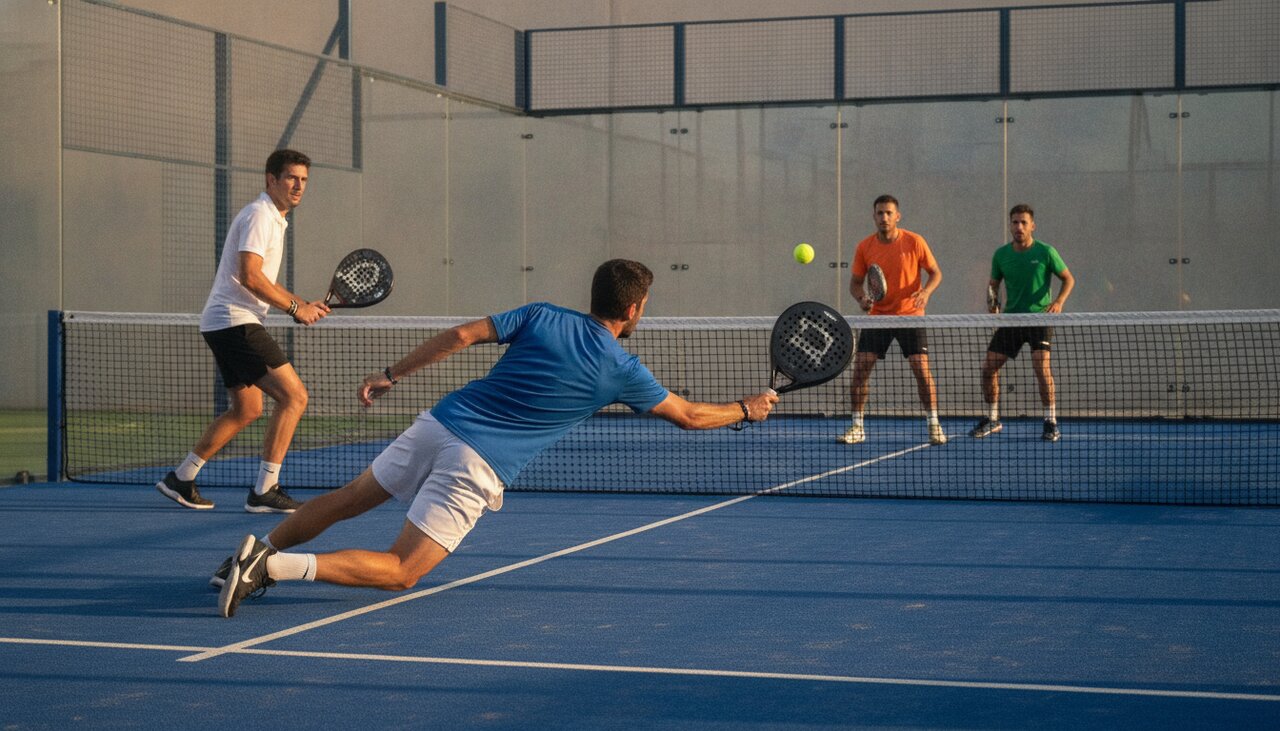
Every club player has one poach they remember. The ball they cut off in front of their partner, the volley that died at the opponents’ feet, the point that felt like a decision rather than an accident. Almost nobody remembers the other four from the same afternoon: the ones where they reached, made contact below the net, and got lobbed into the space they had just left empty. Poaching in padel is a tactic whose wins and losses are remembered at completely different rates, which is why most intermediate players do it far more often than the maths supports.
The tactic is worth having. A well-timed interception ends a rally two shots early and plants a question in the returner’s head that stays there for the rest of the match. Crossing for your partner’s ball is a trade, though, not a free upgrade, and it only pays under conditions you can learn to recognise in about half a second.
What Counts as Poaching in Padel (and What Doesn’t)
A ball down the centre is not a poach. When the ball arrives in the corridor between you and your partner, it belongs to whoever the pair has already agreed takes it, and if you have never had that conversation then owning the middle is the more urgent problem. Taking a middle ball is executing an agreement. It costs you nothing.
A poach is different. You leave your zone to play a ball that was clearly your partner’s, one they could have reached and hit properly. You gain a contact point closer to the net and earlier in the ball’s flight, and you give up your half of the court for as long as it takes somebody to refill it.
The signalled poach off the serve is its own animal, because the server knows it is coming and rotates on the strike. That system runs on padel hand signals and deserves its own practice. What follows is the harder version: the in-rally decision, taken alone, with no signal and no warning to anyone.
The Trade You Make Every Time You Cross
On a tennis court, a poach that doesn’t finish gets passed. On a padel court it gets lobbed, and that difference is the whole tactic.
When you cross and fail to end the point, your opponents are not looking for a winner down your empty tramline. They are looking up. A high ball over the space you vacated forces your pair to reorganise while running backwards, and a pair running backwards in padel ends up defending off the back glass with both players on the same side. Two or three shots later you are still untangling yourselves. The lob is the standard punishment for a bad poach precisely because the enclosed court makes it so easy to hit and so slow to recover from.
That is the real cost, and it is much larger than the cost of simply letting your partner play the ball. So the bar is not “could I reach this?” The bar is “will I finish this, or leave them a ball they must play from below the net?”
Three Green Lights Before You Go
Height comes first. The ball must still be above net height when your racket arrives, not when you start moving. The net is 88 cm in the centre and 92 cm at the posts, and a volley struck from below that line has to travel upward, which means it arrives at your opponents in their strike zone with your court half open. Balls that are dropping fast are not poachable, however reachable they look.
Time comes second, and there is a simple test for it. If you can intercept within two steps taken forward and across, go. If it needs three, you are lunging, your contact point will be outside your body line, and the ball will have dropped below the net anyway by the time you get there. The direction of that first step matters as much as the number: a first step sideways or backwards is not a poach, it is a rescue.
Recovery is the third light and the one most pairs never check. Either your shot ends the rally, or your partner slides across to fill the half you left. If your partner does not rotate, then you do not have a poach available, no matter how inviting the ball looks. Fix the rotation first and the poach becomes usable a week later.
When Not to Cross for Your Partner’s Ball
Do not take a ball your partner is already set on. You are exchanging their balanced, comfortable volley for your stretched one, and paying for the privilege with court position. A stretched forehand from your partner’s zone is worse than a routine forehand from your partner’s racket, every time.
Do not poach from the back of the court. Crossing while you are defending is not aggression, it is abandonment: you leave three quarters of the court open at the exact moment your opponents are hitting downward. The single exception is a ball down the middle while your partner is buried in a corner playing a ball off the wall, and that is a middle ball, not a poach.
Do not cross under a lob to take your partner’s bandeja. You cannot hit down on it, you have stacked both players into one half of the court, and the reply that comes back has an entire empty side to land in.
Two more, both about pattern rather than geometry. Do not poach three times in a row: after the second one your opponents are already looking at the space behind you, and the third interception is the one they have prepared for. And do not gamble on a poach on a break point against your own serve, especially with a new partner, because a failed poach on a big point costs the point and some of the trust you need for the next hour.
Reading the Return Before It’s Struck
The good poaches are not reactions. They are predictions made during the opponent’s backswing, and there are four reliable tells.
Contact point is the strongest. A player striking the ball behind their body cannot change direction; the ball is going crosscourt whatever their intention was. A short, blocked backswing on a low ball says the same thing, since blocking a fast ball down the line requires more racket speed than that swing has.
Wall exits are the second tell. A player taking the ball as it comes off the back glass, moving forward with the ball drifting across them, will overwhelmingly go crosscourt, because down the line off a wall exit is one of the hardest shots in the game.
Third, pattern. Three crosscourt replies in a row buys you the fourth. Club players repeat far more than they think they do, and two games of watching gives you a shot map you can act on.
Fourth, body shape at the net. Watch the opponent’s feet, not their racket. Someone squared up to the net with weight on their back foot is lifting the ball, and the ball they lift is the one you want.
The Rotation Is Half the Poach
Poaching is a two-player action performed by one player. When you cross, your partner moves to your side, and after the point you either stay swapped or reset. Both are fine as long as you both know which. If it is going to be permanent for a few points, say so, since switching sides mid-match works only when it is deliberate.
One word is enough on the way through. “Mine” or “switch” is faster than any hand signal and removes the half-second of hesitation that turns a good poach into a scramble. The player who crosses calls it; the partner reacts. Silence is what leaves two players on the same side watching a ball land where one of them used to be.
Which of you crosses more is decided by handedness rather than ambition. In a right-handed pair, the player on the left has their forehand pointing at the centre, so their poach is a forehand volley moving forward. The player on the right is reaching across their body with a backhand, which is a lower-percentage shot from a worse contact point. That asymmetry is one of the quieter reasons the left-side player finishes more points, and it is worth reading alongside how left and right sides divide responsibility in general.
The Fake Is Cheaper Than the Real Thing
Step in hard, then stop and hold your position. You have not left the court open and you have still moved the returner’s eyes.
A returner who sees movement in the middle does one of two things: hits down the line into the tramline, where the side wall is waiting, or over-hits crosscourt to beat a poach that never came. Both are worse than the ball they were about to play. The fake works best directly after a real poach has hurt them, because the threat has been established, and it costs nothing when it fails.
Situations Where Poaching Pays
After your partner’s good bandeja, the reply floats. That is the standard free poach and the one to take every time: the ball is high, slow, and the opponents are still recovering.
After a chiquita that stayed low, the opponents have to lift. You know the ball is coming up before they hit it, which turns the poach from a gamble into a scheduled shot.
Against a weak returner, poach early and repeatedly. Forcing somebody into down-the-line passing shots under pressure is asking for the shot they practise least.
Against a pair who lob everything, poach less, not more. Their whole game is built on your empty half, and every interception that doesn’t finish hands them the exact ball they want. The advice on playing against constant lobbers applies here more than any other match-up.
Three Drills That Build a Usable Poach
Green light, red light. A feeder sends a mix of high and low balls into one player’s zone while their partner at the net decides whether to cross. Score it +1 for winning a poached point and -2 for crossing on a ball below net height, even if it wins. The negative scoring is the point of the drill. Restraint is the skill being trained, and nothing else teaches it as fast as losing two for a poach that happened to work.
Mandatory rotation. Play points where every poach must be followed by a complete switch of sides, and the pair loses the point immediately if both players end up in the same half, regardless of the rally. This drill is aimed at the partner, who is usually the one failing, not the poacher.
Read the third. The returner is told privately to hit two crosscourt returns and then one down the line. The net player must commit on the third. You will get caught out; that is the exercise. Learning where your reading breaks is more useful than another twenty successful poaches on predictable feeds.
Count them for a few matches. A working rate at club level is one or two interceptions per set that genuinely end the rally, with a handful of fakes around them. If you are crossing five times a set and finishing one, the poach is not winning you points, it is renting you a feeling. Keep the ball in front of you, cross when the height and the two steps are both there, and let your partner play everything else.