By Mario GonzalezStrategy
Handling Mistakes Without Losing Focus in Padel: The Between-Point Reset
Learn to handle mistakes without losing focus in padel. Build a simple between-point reset routine that stops one error from snowballing into a lost set.

Handling Mistakes Without Losing Focus in Padel
You miss a routine volley into the net. Easy ball, wide open court, and you put it in the bottom of the tape. Two points later you double-fault, then you rush a bandeja you’d normally play in your sleep. One mistake became three, and now you’re down a break wondering what happened.
Handling mistakes without losing focus in padel is the skill that decides who holds a lead and who throws it away. Everyone misses. Professionals miss constantly—they just don’t let the last error contaminate the next point. The gap between a 4.0 player and a 5.0 player has less to do with their backhand and more to do with what happens in the seven seconds after a bad shot.
This is a trainable mental routine, not a personality trait. Here’s how to build one.
Why One Mistake Becomes Three
A single missed shot costs you one point. The spiral that follows costs you games. Understanding why the spiral happens is the first step to stopping it.
The Attention Hijack
When you make a mistake that matters to you, your brain replays it. You’re standing at the baseline waiting to receive, but a part of your attention is still watching that volley sail into the net. That replay pulls focus away from the only thing that helps you: the ball that’s about to come.
Split attention destroys padel timing. You react a fraction late, your footwork gets lazy, and you reach for balls you should have moved to. The second mistake usually isn’t bad luck. It’s the direct result of playing the previous point in your head while the current one happens in front of you.
Emotional Carryover
Frustration narrows your decision-making. Angry players default to two bad habits: hitting harder and going for too much. After a miss, the urge to “make up for it” pushes you toward low-percentage shots—the screaming winner down the line instead of the safe cross-court you’ve hit a thousand times.
Your partner feels it too. Padel is a doubles game, and tension travels across the court. When one player visibly unravels, the other starts covering more than their share, and the team’s structure collapses.
The Seven-Second Reset
Between points in padel you have roughly seven to fifteen seconds. That window is enough to run a complete mental reset if you have a routine ready. Top players do the same sequence after every point, win or lose, so it becomes automatic under pressure.
Step One: Physical Release
The body holds tension the mind creates. Break that loop first.
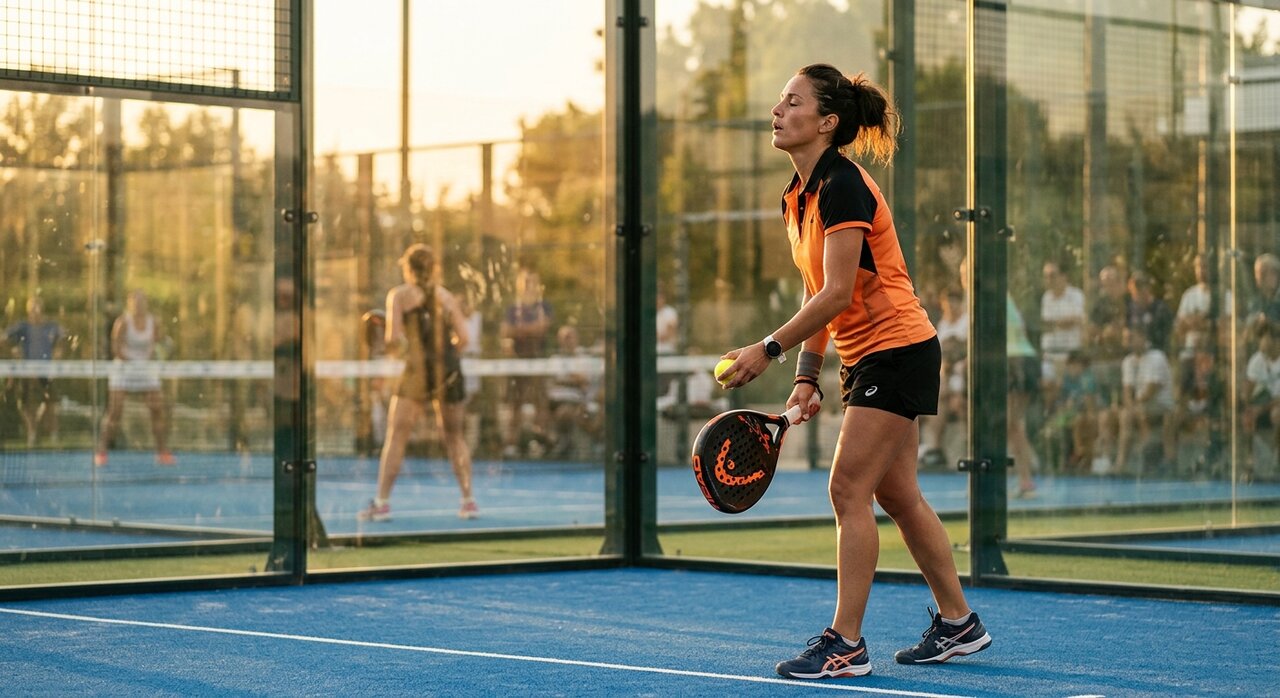
After a bad point, turn away from the net and walk three or four steps toward the back glass. Loosen your grip completely—let the racket hang. Shake out your hitting hand. This isn’t superstition; releasing grip pressure physically interrupts the stress response, the same one covered in staying calm under pressure during break points.
Many pros also use the strings. Adjusting your strings with your non-dominant hand gives your eyes somewhere neutral to go and your hands something to do that isn’t replaying the miss.
Step Two: One Breath, Then Done
Take one slow breath, longer on the exhale than the inhale. A four-count in, six-count out drops your heart rate and signals to your nervous system that the threat has passed.
As you exhale, let the point go. Some players use a physical cue—wiping the hand on the shorts, a single bounce of the ball—as the moment they “delete” what just happened. The cue matters less than the consistency. Pick one and use it every single time.
Step Three: Refocus on the Next Ball
End the routine with a specific, forward-looking thought. Not “don’t miss again”—that keeps your attention on missing. Instead, give yourself one concrete instruction for the next point: “deep return,” “move my feet early,” “first volley cross-court.”
A single tactical cue crowds out the replay. Your mind can’t rehearse the last error and plan the next shot at the same time, so you fill the space deliberately.
What to Tell Yourself After a Miss
The words in your head shape the next point. Most players talk to themselves after a mistake in the worst possible way.
“I’m playing terribly” is a verdict on you as a player, and it sticks around for the rest of the match. “That ball sat up and I leaned back” is a description of one shot, and it points at a fix. Trade global judgments for specific observations. A specific observation is something you can correct on the very next point; a character judgment just adds weight.
Avoid the trap of demanding perfection. A realistic internal standard for club padel is that you’ll miss a meaningful chunk of your shots—even strong intermediate players spray plenty of balls every match. When you accept that misses are part of the game rather than evidence of failure, each one loses the power to rattle you. This mindset connects directly to dealing with losing streaks, where the same self-talk patterns play out over weeks instead of seconds.
Common Game Situations
The reset matters more in some moments than others. These are the situations where focus leaks fastest.
After Missing an Easy Put-Away
Blowing a sitter stings more than missing a hard shot, because you “should” have made it. That extra sting is exactly what makes the next point dangerous. Run the full reset here, even though the point felt trivial. The emotional size of the miss, not its difficulty, determines how much it can damage your focus.
After Your Partner Makes the Error
Your reset routine isn’t only for your own mistakes. When your partner dumps an easy ball, your job is to stay neutral. A visible sigh or a slumped shoulder tells them you’ve lost confidence in them, and a tense partner plays worse. Give a quick “no problem, next one” and reset as if it were your own miss. Strong communication patterns are covered in the broader padel mental game guide.
During a Run of Errors
Sometimes the reset between single points isn’t enough and the misses keep coming. This is when you use the longer breaks—the change of ends, the gap between games. Take the full time allowed. Slow everything down, simplify your targets to the safest options, and aim to win the next point with margin rather than brilliance. Stopping the bleeding beats trying to win it all back at once.
A Drill for Training the Reset
You can rehearse the reset deliberately instead of waiting for matches to throw mistakes at you.
Set up a normal points drill with your partner against another pair, but add one rule: every time anyone on your team makes an unforced error, the player who missed has to complete the full reset out loud before the next point starts. Walk to the back glass, say the breath count, then announce the tactical cue for the next ball (“deep return”). Saying it out loud makes the steps visible, so your partner can call you out if you skip one.
Run this for fifteen or twenty minutes. The point isn’t to play your best padel during the drill—it’s to stamp the sequence into muscle memory so it fires on its own when a real match gets tight. After a couple of weeks, drop the “out loud” part and let the reset run silently. By then it should feel strange not to do it.
A second, simpler version works in solo wall practice. Each time you mishit against the wall, stop, run the physical release and one breath, then restart. You’re training the link between “I missed” and “I reset” thousands of times, far more reps than any match gives you.
Building the Habit
A reset routine only works under pressure if it’s automatic, and automatic comes from repetition in low-stakes moments.
Practice the sequence during friendly matches and even in drills, after every point, when nothing is on the line. Turn away, release the grip, breathe, set your cue for the next ball. If you only attempt the reset during tight matches, you’ll forget it exactly when you need it most. Build it when it’s easy so it’s there when it’s hard.
You can also train your tolerance for mistakes directly. In practice, set a rule that you’re not allowed to react negatively to any error for an entire session—no muttering, no racket drops, no slumping. It feels artificial at first. After a few sessions, the calm response starts to feel normal, and that normal carries into matches.
Pair the mental work with the practical side of preparation. A solid pre-match routine lowers your baseline tension before the first ball, which means fewer frustration spikes to manage once you’re playing.
The players who frustrate opponents most aren’t the ones who never miss. They’re the ones who miss, reset, and play the next point exactly as if the last one never happened. Build that reset, run it after every point, and you’ll stop handing away the games you’ve already earned.