By Mario GonzalezFitness
Supplements for Padel Players: Do You Actually Need Them?
An evidence-based guide to supplements for padel players. Learn which ones have real backing, which are a waste of money, and what to fix in your diet first.
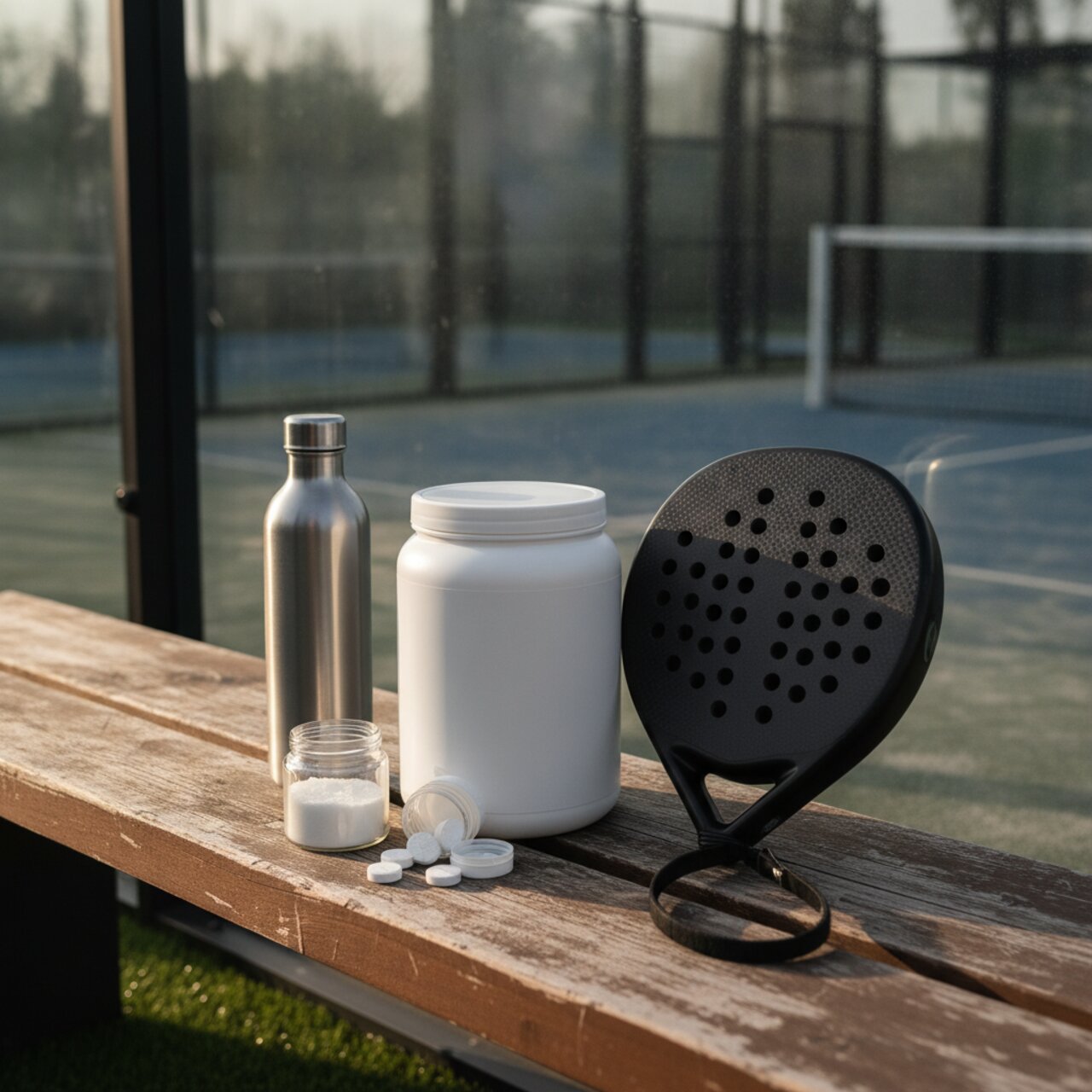
Walk into any padel club and you will see players sipping bright pink drinks and swallowing capsules before a match, convinced the magic is in the bottle. Most of it is wasted money. The honest answer to whether you need supplements for padel players is: probably not the ones you are buying, and definitely not before you have your food, sleep, and hydration sorted. A handful do have real scientific backing for the stop-start demands of padel. The rest trade on hope.
This guide separates the supplements worth considering from the marketing. No brand deals, no miracle claims, just what the research supports for a sport built on repeated sprints, lunges, and 90-minute matches.
Fix Your Diet Before You Buy Anything
A supplement is exactly that: something added on top of a diet that already works. If you eat poorly, skip meals, and turn up dehydrated, no capsule fixes that. You would be pouring money into the gap instead of closing it.
Most amateur players who feel sluggish on court are not deficient in some exotic compound. They are under-eating carbohydrates, short on sleep, or starting matches already dehydrated. Sort those three first. Our guide on what to eat before a padel match covers the fuel side, and the hydration guide for padel players handles the rest. Get both right and you will feel a bigger jump than any tub of powder delivers.
There is one genuine exception worth flagging. If a blood test shows you are low in iron, vitamin D, or B12, that is a real deficiency a doctor should address. That is medical treatment, not performance supplementation, and it is the only category where “you need this” is literally true.
Supplements With Real Evidence Behind Them
A small group of supplements has been studied enough that the benefits are well established. None of them are dramatic, and none replace training. But for the specific demands of padel, these are the ones with a case.
Creatine Monohydrate
Creatine is the most researched sports supplement in existence, and it happens to suit padel well. The sport runs on short, explosive efforts: a sprint to the net, a hard smash, a lunge for the low volley. Creatine helps your muscles regenerate energy between those bursts, which is exactly the system padel hammers.
The effective dose is 3 to 5 grams a day, taken consistently, with no need for the old “loading phase.” Timing does not matter much, so take it whenever you will remember, with or without food. It is cheap, the monohydrate form is the only one worth buying, and you can ignore the pricier “HCL” or “buffered” versions that charge more for no added benefit. The safety record over decades is excellent. The trade-off is a couple of kilos of water weight in the muscle, which bothers some players and helps others. If you lift weights alongside your padel, creatine is the single supplement most likely to do something.
Caffeine
Caffeine is a proven performance aid for reaction time, focus, and perceived effort, all of which matter when you are deep into a third set. A dose of 1 to 3 milligrams per kilogram of body weight, taken 45 to 60 minutes before a match, sharpens you up. For a 75-kilo player that is roughly 75 to 225 milligrams, or one to two cups of coffee.
The catch is tolerance and timing. If you already drink coffee all day, the effect on court is blunted. And caffeine within six hours of bedtime wrecks the sleep that actually drives your recovery, so a late-evening match changes the maths. Treat it as a tool for specific games, not a daily crutch.
Electrolytes
If you play long matches in heat and sweat heavily, plain water is not always enough. You lose sodium through sweat, and replacing it helps you hold fluid and avoid the cramping that ends matches early. An electrolyte tablet or a properly mixed sports drink during a hot two-hour session earns its place.
This is not the same as the sugary energy drinks marketed at athletes. What you want is sodium, with some potassium and magnesium, not a hit of stimulants and dyes. Most players who train in mild weather get enough salt from food and do not need to supplement at all.
Supplements That Might Help, With Caveats
A second tier has some evidence but a weaker case for padel specifically. Worth knowing about, not worth prioritising.
Protein powder is the obvious one. It is not magic, just a convenient way to hit your daily protein target if real food falls short. The target is roughly 1.6 to 2 grams of protein per kilo of body weight if you train hard. Hit that with chicken, fish, eggs, dairy, and beans and you need no powder at all. A scoop after a session is fine for convenience, covered more fully in our post-match nutrition guide, but it is food in a tub, not a performance booster.
Beta-alanine has decent evidence for efforts lasting one to four minutes, where it buffers the burn of fatigue. Padel points rarely last that long, so the benefit is marginal here compared to a sport like rowing. Omega-3 fish oil supports general recovery and joint health, which an ageing knee or shoulder might appreciate, but eat oily fish twice a week and you have the same thing on your plate.
What to Skip
Plenty of products survive on clever marketing rather than results. Pre-workout blends are mostly caffeine plus a pile of unproven extras at doses too low to matter; you would do better with a coffee and a banana. BCAAs are pointless if you already eat enough protein, which most people do. Fat burners, testosterone boosters, and anything promising to “unlock your potential” belong in the bin.
Be especially wary of proprietary blends that hide individual doses behind a single total. If a label will not tell you how much of each ingredient is in there, assume the answer is “not enough to work.”
Safety, Quality, and What’s Actually in the Tub
The supplement industry is loosely regulated, which means what the label promises and what the powder contains do not always match. Independent testing has repeatedly found products spiked with stimulants, contaminated with banned substances, or simply containing far less active ingredient than advertised. For a recreational player this matters less than for a competitor, but nobody wants to pay for filler.
Look for a third-party testing seal such as Informed Sport or NSF Certified for Sport. Those programmes test batches for contaminants and banned substances, and the certification is the closest thing to a guarantee that what is on the label is in the bottle. If you compete in any federation event subject to anti-doping rules, treat certification as non-negotiable, because “I didn’t know it was in there” is not a defence.
A few practical habits keep you safe. Introduce one supplement at a time so you can tell what is doing what. Start at the low end of the dose range. And if you take medication or have a health condition, run anything new past your doctor first, particularly stimulants like caffeine if you have heart issues or high blood pressure.
A Sensible Approach for Most Players
If you play padel two or three times a week and want a realistic starting point, here is the order that makes sense. Nail your diet, sleep, and hydration first, because they outweigh everything that follows. Add creatine if you also train in the gym and want the explosive edge. Use caffeine selectively before important matches. Carry electrolytes for long, hot sessions. Reach for protein powder only when real food is genuinely inconvenient.
Notice what that list does not include: anything exotic, expensive, or promising transformation. The supplements that work are cheap, boring, and backed by decades of study. The ones that drain your wallet are usually the loudest.
Before you spend a cent, get the foundations right. Read up on recovery between matches and build a real padel fitness training program, because those two habits will do more for your game than any shelf of bottles. Supplements are the finishing touch on a system that already works, never a shortcut around building one.