By Mario GonzalezStrategy
Padel Pair Head-to-Head: Which Duo Owns Your Group
Two duos, one record. The padel pair head-to-head in Padellog counts only the matches where your exact team met theirs, and settles the group argument.

Some rivalries in a padel group aren’t between two players. They’re between two teams: you and your regular partner against the duo who always seem to walk off court smiling. A padel pair head-to-head is the record that settles that one, because it holds the partners constant and counts only the matches where those two exact pairs met.
Padellog builds it from matches you have already logged. There is no spreadsheet to filter and no debate about who won the tight one back in March. Two teams, one tally, updated the moment a result goes in.
Why a player record doesn’t settle a doubles argument
A player-versus-player record is the obvious place to start, and it’s genuinely useful for tracking your history against a specific rival. It has one blind spot: partners. You might lead a rival 8-5 while having played six of those meetings alongside the strongest player in your group. That record is measuring your partners as much as it measures you.
Fix both partners and the noise disappears. When the same two duos meet ten times, the result is a fact about the matchup, not about who got the good draw that week. It’s the closest thing padel has to a clean rivalry stat, and it’s the one your group will actually argue about.
What the padel pair head-to-head shows you
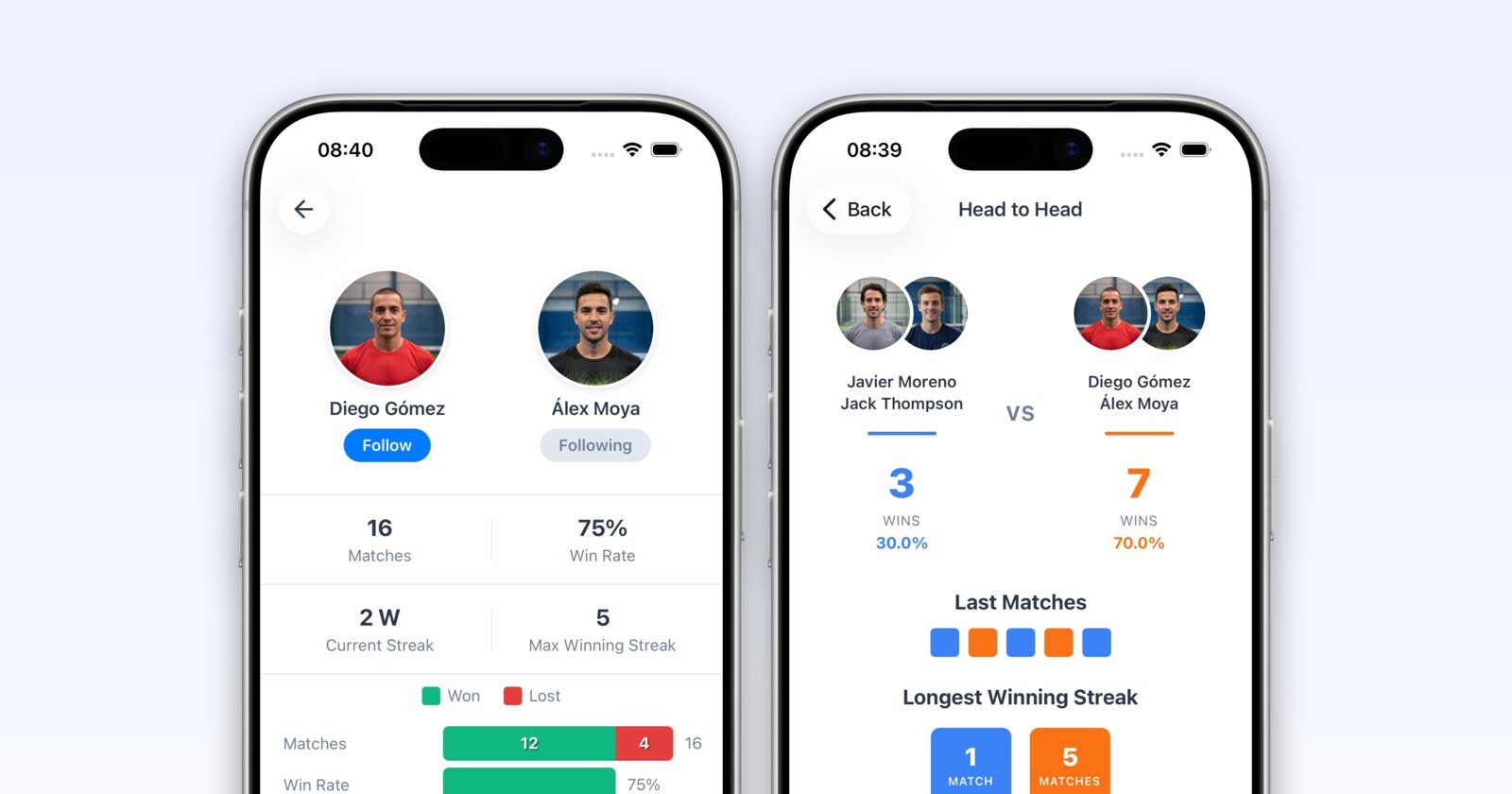
The screen opens with both duos side by side, avatars, names and all. Each one gets a colour, blue for the first pair and orange for the second, and that colour follows the data down the rest of the screen. Under each duo sits the number of wins and the win percentage to one decimal, so a 7-5 lead reads as 58.3% rather than a vague “we’re ahead”.
Below that, the last five meetings appear as five coloured boxes, oldest on the left and most recent on the right. It’s a small thing that answers a big question: who has the form right now. A 9-7 overall lead looks very different when the last five boxes are all orange.
Next comes the longest winning streak for each pair, side by side. That’s the run neither team forgets, and it’s usually the number someone in the group has been exaggerating for months. Then a full-year calendar shows every date the two duos played, each day coloured by the winner. Scanning it, you see the shape of the rivalry: the run in February, the quiet summer, the three straight losses in October you’d rather not discuss.
A button at the bottom opens every match between the two pairs, so any result you want to check is one tap away with its score attached. Tapping either duo in the header takes you to that pair’s own profile, which is where their overall record, win rate and other opponents live.
Opening it takes three taps
Start from a pair profile. You get there by tapping the two names on either side of a match card, or by tapping a duo on the pairs leaderboard. That opens the record for those two players as a team: matches together, win rate, current and best streak.
Scroll down that profile to the opponents chart. It lists the duos this pair has faced most, ranked by matches played, with a bar for each. Tap the bar belonging to your rivals and the pair head-to-head opens on the two of you.
The chart itself is worth a moment before you tap anything. The duo at the top is the one you’ve played most, which is usually the one the whole rivalry is built on, and the bar lengths tell you at a glance which head-to-heads have enough matches behind them to mean something.
How many meetings before it counts
The same discipline applies here as with any stat. Beating a pair 2-1 tells you almost nothing, because a single tight third set flips it. Treat anything under about six meetings as a small sample and anything past ten as a genuine edge.
Pair head-to-heads build more slowly than player ones, since both teams have to be intact for a match to count. In a settled group with regular partners that’s fine, and the records deepen every week. In a group that rotates partners constantly, your player head-to-heads will fill up first and the pair records will stay thin for a while. Both are in the app, so use whichever has the matches behind it.
What you do with the record
A pair that owns you is a tactical problem, not bad luck. Once the number is on screen, the next question is why, and the answers are usually specific: they lob your partner’s side relentlessly, or they win every point through the middle. That’s a matchup to prepare for, and doubles positioning is where most of the fixes start. Sometimes the answer is simpler still, and swapping which of you plays the backhand side changes the whole match, which is where knowing your best side of the court pays off.
The record also tells you something about your own team. If your duo is behind against three of your four regular opponents, the problem may not be the matchup at all, and your pair stats will show whether you win more alongside someone else. That’s a harder conversation than a rivalry, and it’s the more valuable one.
Then there’s the part that makes a group fun. Everyone knows who leads whom, the calendar is public, and the next meeting has stakes because a record is on the line and not just an evening. Groups that keep score this way tend to be the ones that stay together.
Log the match, get the record
Nobody maintains pair head-to-heads by hand for long. The filtering is tedious, the losses quietly go missing, and within a month the spreadsheet is a memory. Log your matches in Padellog and every pair head-to-head in your group builds itself, wins, streaks, calendar and all.
Find out which duo actually owns the matchup. Get Padellog on iOS or Android, log your next match, and let the record answer.