By Mario GonzalezStrategy
Playing With a Padel Partner Better (or Worse) Than You
Playing with a padel partner better or worse than you changes every decision you make. Shot selection, court coverage and the apology habit that loses games.

Look at the names on your next club booking. The chance that all four sit inside the same half-level is small, because most club matches are assembled from whoever was free on Thursday. Playing with a padel partner better than you, or a good deal worse, is the normal case rather than the exception, and almost nobody is taught how to do it.
The usual advice is useless. “Just play your own game” ignores the fact that the other pair has already spotted the gap and is about to build their whole afternoon around it. Uneven pairs win matches all the time. They win them when both players agree, before the first serve, on what each of them is actually there to do.
What a Level Gap Costs You Before the First Point
Decent opponents solve an uneven pair inside three games. They send roughly two thirds to three quarters of their balls at the weaker player, they serve at that player’s backhand, and they lob the stronger player to drag them off the net. There is nothing unsporting about it. You would do the same.
The real cost is not that the weaker player touches more balls. It is that they touch them under pressure, on their least comfortable side, with less recovery time in between. Someone who looks perfectly solid in a warm-up rally can come apart after twenty consecutive attacks aimed at their feet. At the same time the stronger player goes cold, stops moving, and starts drifting sideways to rescue balls that were never theirs, which opens exactly the gaps the opponents were hoping for.
That gives the pair a job description. Keep the weaker player hitting balls they can actually hit, and keep the stronger player busy without letting them take the match over. Everything below is a version of those two sentences.
The Sixty-Second Conversation Before You Start
Have it on the walk to the court, not after the third double fault. Three things need settling, and none of them require you to say out loud that one of you is better.
Who takes the middle. Pick the rule now and stop renegotiating it mid-rally. In an uneven pair the useful version is: anything above net height in the centre belongs to the stronger player, anything below net height belongs to whoever is on the side the ball came from. That gives the stronger player the balls they can punish and leaves the weaker player the ones they can block.
Which side each of you plays. The player with the shakier overhead should take the right, because the left side eats bandejas and víboras all afternoon. If the weaker player is a right-hander with a nervous backhand, the right side also hides that wing behind the tramline instead of exposing it in the middle. The left side versus right side guide covers the trade-offs in full.
What you want to hear during the match. Agree the vocabulary: short calls only, no technical advice until the change of ends. Most on-court coaching is a way of managing the coach’s own frustration, and it lands on the partner as one more thing to think about while a smash arrives.
When Your Padel Partner Is Better Than You
Shrink your shot menu to three balls
The errors that sink an uneven pair are rarely technical. They come from ambition: the passing shot down the tramline, the drop volley on 30-30, the flat drive at a player standing two metres from the net. Under pressure, choose from three balls only.
The first is a deep lob, aimed at the last two metres of their court. The second is a crosscourt ball at medium pace to the middle of their side, which is dull and almost impossible to attack. The third is a block volley with no backswing when you are at the net. Roughly two thirds of your defensive balls should be that lob, and the defensive lob is worth practising precisely because it is the shot a targeted player needs most.
You are not being negative. You are removing decisions, and removing decisions is what stops your unforced error count from doubling when the pressure arrives.
Hold your box
The most damaging habit is retreating. A targeted player quietly leaks backwards from the net over three or four points, ends up in no man’s land, and then their partner cannot predict where they are. Two defenders standing at different depths give away more points than one weak volley ever will.
Stay where the pair agreed to be. If you genuinely cannot handle the ball coming at you, lob it or block it, but do it from your position. A predictable player at the right depth is far more useful than a mobile one who is somewhere different each point.
Stop apologising
Count the “sorry”s in your next match. Club players who feel outclassed produce twenty or thirty of them, and each one does two things: it trains you to treat every error as a debt, and it forces your partner into the role of reassurer between points, which is not a role that helps anyone hit the next ball.
Swap the apology for a neutral reset word you say to yourself. “Next.” Then get back to position. Save any real conversation for the change of ends. Errors stop being a problem when they stop being an event, which is also the argument in the guide on handling mistakes without losing focus.
When you are being hunted
Once you realise every ball is coming to you, three adjustments buy you time. Shorten the backswing to nothing at the net and let the ball rebound off a firm racket face. Aim about a metre above the net rather than skimming it, since half of the errors in this situation are into the net rather than long. And take a step back from the net if you are being smashed at, so the ball reaches you at waist height rather than at your chin.
The one thing not to do is start hitting harder. Trading pace with a better player is the fastest way to hand them the match.
When You’re the Better Player in the Pair
Cover more court, not more of your partner’s court
The instinct is to roam. Resist most of it. Take the extra ball in the middle, take anything floating above net height, and take the lob that lands between you. Do not step across your partner’s hip to intercept a ball they were already moving to, and never cross behind them, because you leave two thirds of the court open and you tell the opponents exactly where to hit next.
A workable split is closer to 60/40 than 50/50, defined by ball height rather than by geography. The post on asymmetric pairs in mixed padel goes deeper into how to divide the court when two players have genuinely different reach and power.
Build the point, don’t finish it
The temptation at 3-3 is to end every rally personally with a smash off the back glass. It works twice, then the miss rate climbs and your partner has stopped moving because they are watching you play. Better to keep the pattern simple: lob deep, force a defensive overhead, and let the pair walk in together.
Feed your partner balls they can succeed with. If they volley reasonably but panic on overheads, put the pressure on the opponent who then has to hit crosscourt into your partner’s volley rather than lob over them.
Two instructions per set, maximum
Mid-match coaching almost never improves anything on the day. Technique does not change in ninety seconds, and every correction adds a thought to a player who already has too many. Save it for after, or say one structural thing — “lob more” is fine, “your grip is wrong” is not.
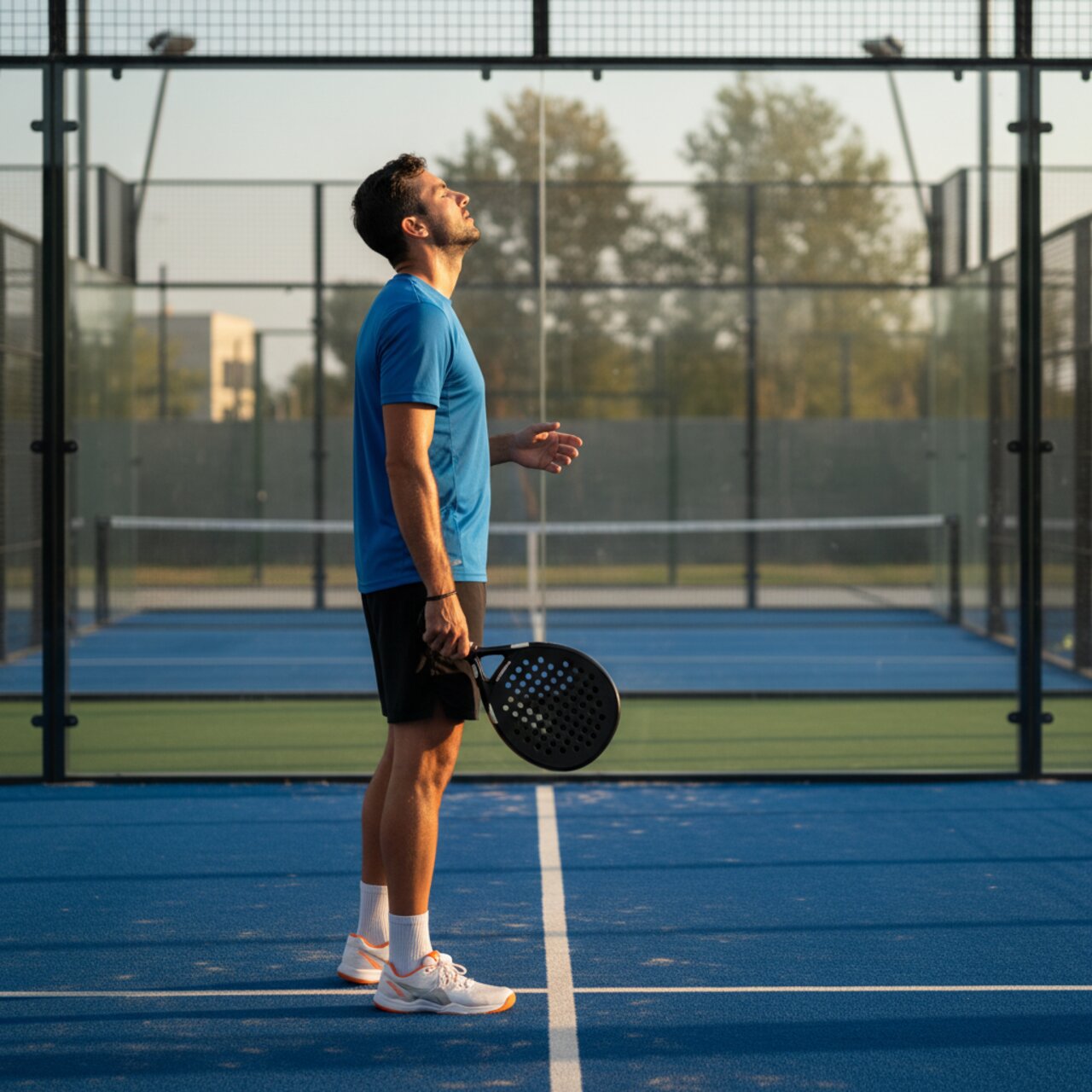
Watch your body language too. The sigh, the hands on hips, the little look at the sky after a missed volley: your partner reads all of it, and they play worse afterwards. Read the complete guide to partner communication if this is a habit you recognise in yourself.
Situations That Decide These Matches
The golden point. The receiving pair chooses which side receives, so pick the stronger player’s return whenever the point matters. On serve, the stronger player should be the one taking the aggressive option. See the detail in golden point strategy.
Break points against you. Whoever has the better first serve serves the games that matter most in the rotation, and the weaker player should be encouraged to serve to the body rather than to the corners: less pace, fewer double faults, harder to attack.
After a bad game. Change something structural rather than something emotional. Swap the return order, switch sides for a game, or move both of you a metre deeper. It gives the pair a task instead of a mood.
Social formats. In an americano or a rotating format you will play with three levels in one evening. Treat each pairing as a fresh sixty-second conversation and you will win more of them than the player who plays the same way regardless of who is next to them.
Common Mistakes and How to Fix Them
The stronger player poaches everything. The weaker player stops moving entirely by the second set. Fix: let the ball height decide, not your ambition.
The weaker player tries to prove they belong. Winners attempted from bad positions, usually early in the match. Fix: the three-ball menu, and accept that a boring lob is a contribution.
Both players drift to the middle. Common when the weaker player retreats and the stronger one compensates. Fix: agreed depths, restated at every change of ends.
Post-mortems between points. Ten seconds of analysis costs the next point. Fix: nothing tactical until you swap ends, then twenty seconds, then done.
Pretending the gap doesn’t exist. Playing a symmetric game plan against opponents who are targeting one player is stubbornness, not fairness. Fix: name it privately, plan around it, and move on.
Four Drills for Uneven Pairs
Everything to one player. Two opponents attack the weaker player only, twenty balls in a row, while the stronger player stays put and may not intervene. It teaches one player to survive and the other to stop rescuing.
Three-ball menu. Play a set where the weaker player may only lob, block or hit crosscourt at medium pace. No winners allowed. Count how many points the pair wins anyway; the number surprises most people.
Silent set. One full set with no words except mine, yours and out. It kills mid-match coaching and forces the pair to solve position by watching each other.
Height rule points. Play points where the stronger player may only take balls above net height in the middle, and gives up the point automatically if they take a low one from their partner’s zone. Four or five points is usually enough to make the boundary automatic.
An uneven pair is not a compromise, and being the weaker player in a good match is the fastest way to improve that exists. What ruins these matches is neither the gap nor the errors, but the small negotiations that never happened: who takes the middle, who takes the risk, what gets said between points. Sort those out on the walk to the court and the level difference becomes a detail. If you are curious about which partners actually bring out your best results rather than which ones feel comfortable, the numbers behind finding your best padel partner tend to be less obvious than the feeling.