By Mario GonzalezStrategy
Owning the Middle in Padel: Attacking and Defending the Centre
Most padel points go through the middle. Learn who takes the centre ball, how to attack down it and how to defend the gap between you and your partner.
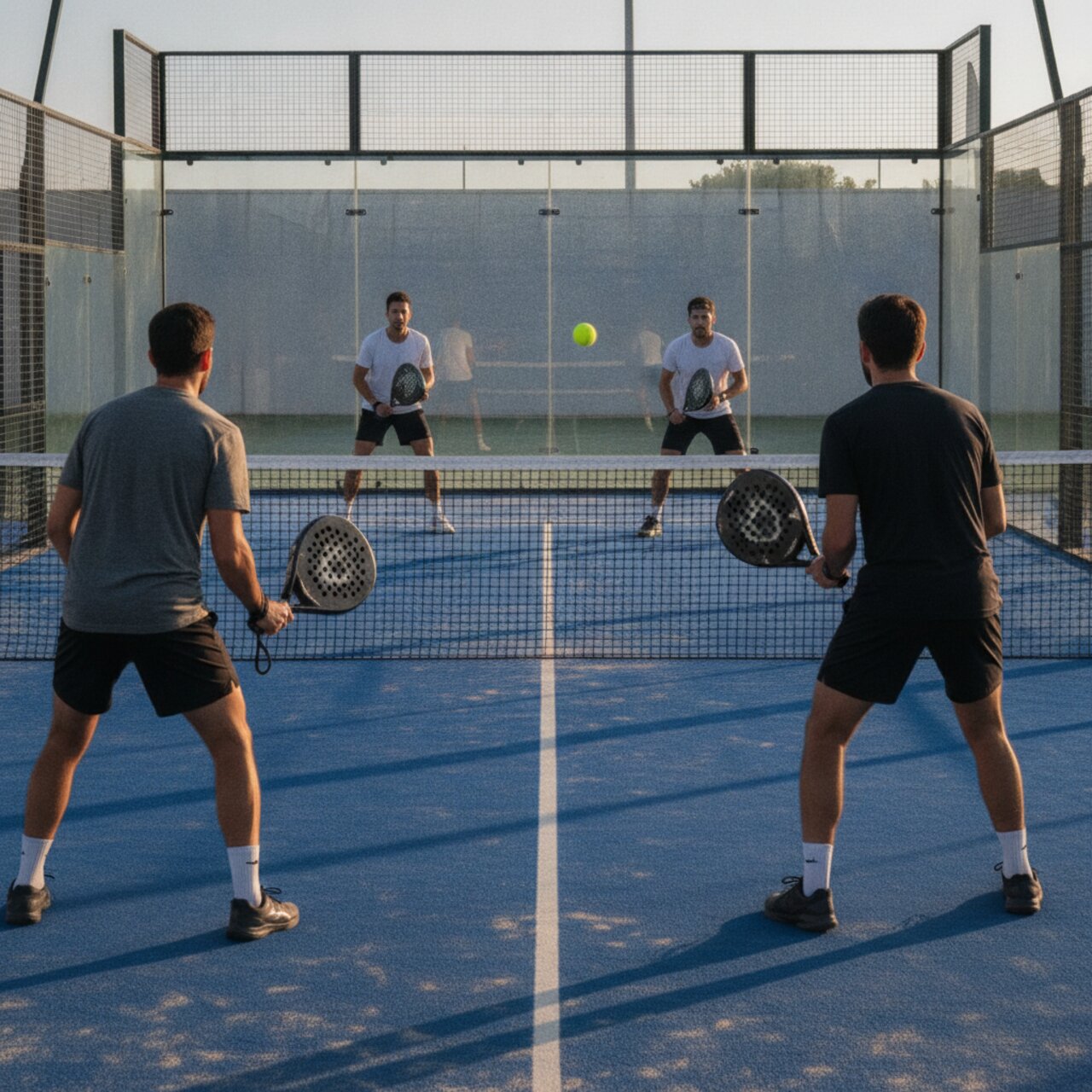
Watch any decent pair for twenty minutes and count where the balls land. The middle in padel takes more traffic than both sidewalls combined, and the pair that decides in advance who plays that lane wins a pile of points nobody notices them winning. The centre is not a place you stand. It is a corridor roughly two metres wide running from net to back glass, and every rally is a negotiation over who owns it.
Most intermediate pairs never have that negotiation. They both go for the ball down the middle, or neither does, and the point ends with two players looking at each other. That hesitation costs more matches than a weak backhand ever will.
Why Most Padel Points Are Won Through the Middle
The centre is the highest-percentage target on the court for one boring geometric reason: the net is lowest there. It sits at 88 cm in the middle and 92 cm at the posts. Four centimetres sounds like nothing until you are hitting a flat volley at pace, where it is the difference between a clean winner and a ball in the tape.
The centre also gives you the longest available court. A crosscourt drive to the corner has to travel over a higher net into a shorter diagonal window. A ball hit straight down the middle has the full length of the court to land in, and the two shortest run-ups for whoever is receiving it.
Then there is the human factor, which matters more than the geometry. A ball to the middle belongs to nobody by default. It arrives at the seam between two players, forcing a decision under time pressure, and any decision made late produces a poor shot. You are not just aiming at a target. You are aiming at a disagreement.
Professional pairs attack the middle constantly for exactly this reason, and they defend it just as hard. Their positioning looks narrow to the untrained eye because they are covering the corridor first and conceding the alleys second. That inversion is what separates a pair that plays together from two players who share a court.
Who Takes the Middle Ball in Padel
Sort this out before the match, not during it. Every rule below has exceptions, but a mediocre rule that both players know beats a perfect rule that only one of you has thought about.
The forehand takes it, most of the time
The default in a right-handed pair is that the middle ball belongs to the player on the left side, because their forehand covers the centre. This is the reason the left is the attacking side and the reason lefties are so valuable on the right. If you have never sorted out who plays where, choosing between the left and right side is the conversation to have first, since it dictates every middle ball afterwards.
The rule holds cleanly at the net when the ball comes at chest height or above. It starts breaking down as the ball drops. A knee-high ball to the middle is often better taken with a backhand volley by the player on the right than with a stretched, low forehand from the left.
Whoever is moving forward takes it
Momentum beats the forehand rule. If one of you is stepping in toward the net and the other is holding position or retreating, the ball belongs to the player moving forward, regardless of which wing it lands on.
The reason is simple: a shot hit while moving toward the target is more accurate and better balanced than a shot hit while stationary or backing up. This one situation accounts for most of the middle balls that get let through in club padel. Both players are static, both apply the forehand rule literally, and the ball skids off the back glass.
The player with the better angle takes it
Some middle balls are not really in the middle. A ball that has drifted 30 cm to the right of the corridor, is dropping, and is closer to the player on the right belongs to the player on the right, even if it is technically a centre ball and even if it is on their backhand.
Judge by who can hit it in front of their body. If one of you would be reaching across and the other would be striking it comfortably in front, the second player takes it. Say so out loud, every time.
Two forehands in the middle
A right-hander on the left and a left-hander on the right creates a pair with two forehands guarding the centre, which is why so many top pairs are built this way. The upside is obvious. The problem is that both players now want the middle ball, so the confusion moves from nobody-takes-it to both-take-it.
The fix for lefty-righty pairs is a fixed call, not an instinct. Decide that one of you owns the corridor by default and the other only crosses when explicitly called off. Ambiguity is worse than a suboptimal wing.
Attacking Through the Middle
Aim for the seam, not the centre line. The target is the shoulder of whichever opponent has the weaker claim to the ball, roughly half a metre off the true centre, which is where the ownership question becomes hardest to answer.
Volley the middle when both opponents are at the net. A crosscourt volley against two net players gives them an easy angle back. A firm volley down the middle at their feet forces one of them to play a low, defensive shot from an unclear position, and their reply usually pops up.
Serve down the T when you want a weak return. The serve to the centre reduces the angle available to the returner and hands your partner an easy first volley, because the reply has nowhere to go but back through the middle. Use it against a returner who has been carving you up with crosscourt returns.
Hit the bandeja to the middle when you are defending your net position. Most players are taught to bandeja crosscourt, which is right when you want to reset and hold the net. When you want the point to end sooner, the middle bandeja at the far player’s feet forces a low reply that your partner can attack. Just be clear about which one you are hitting, since a middle bandeja that sits up feeds them a free attack.
Attack the middle hardest against a pair that has just switched sides. A pair who has changed positions mid-rally is momentarily unsure whose forehand covers the centre, and that uncertainty lasts about two shots.
Defending the Middle
When you are the pair getting attacked, the corridor is what you protect first. Concede the lines. A ball down the sidewall is playable off the glass and gives you a rebound to work with, while a ball through the middle is usually already past you.
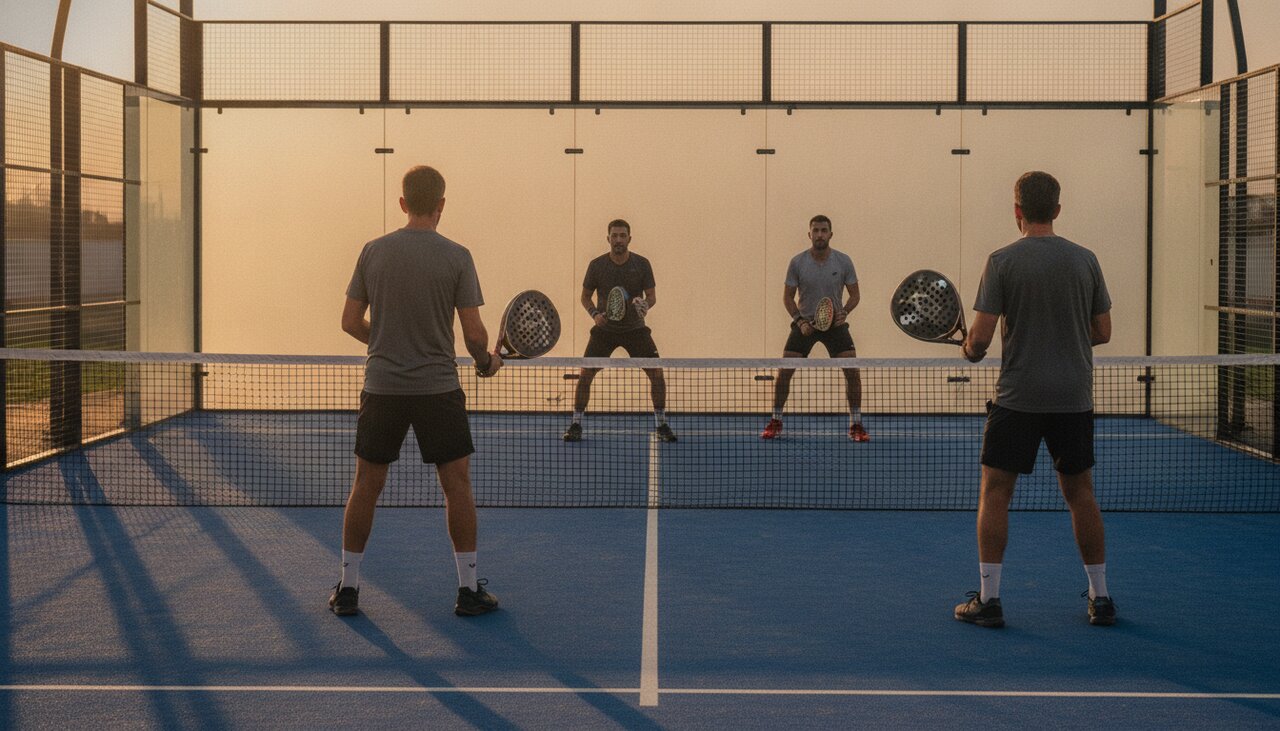
Stand narrower than feels natural. Most club pairs at the net stand too wide, guarding two alleys nobody is aiming at, and leave a two-metre gap in the middle that any competent opponent will find within three shots. Close to roughly two metres apart at the net and let the outside balls come.
Move as a unit, not as two independent players. If your partner shifts a metre to their left to cover a wide ball, you shift with them. The gap between you should stay constant regardless of where either of you is standing, which is the whole idea behind the shadow movement covered in the doubles positioning guide.
When you are both back and defending, the middle is where you should be sending the ball too. A lob to the centre is safer than a lob to the corner, since it has more court to land in and it makes both opponents hesitate about who plays the overhead. A defensive shot that creates a decision for them is worth more than a bolder shot that only creates a risk for you.
Common Situations Where the Middle Decides the Point
The return of serve you both left. The serve comes down the T, both of you are at the back, and it passes between you. Fix: the player on the left claims every T serve unless they call otherwise before the point.
The lob that lands between you at the net. Neither player wants to give up their net position, so both wait a fraction too long and it drops. Fix: the player on the left takes it by default, and the other retreats immediately without waiting to see the result.
The smash you both went for. The most expensive middle ball in padel, because you can collide. Fix: only one voice is allowed to claim overheads, and the call happens the moment the ball leaves the opponent’s racket.
The counter-drive up the middle when you are at the net. A pair being attacked will often drive flat through the centre precisely because your positioning is stretched. Fix: after hitting an overhead, recover to the corridor first and the sideline second.
Almost all of these are communication failures rather than technical ones, which is why talking with your partner improves your results faster than any shot you could practise instead.
Two Drills for the Centre Corridor
Middle-only feed. One player feeds from the back, alternating balls into a two-metre corridor at varying heights, while both net players take everything without stepping outside the corridor. Every ball must be claimed out loud before contact. Twenty balls, then swap. The rule is that a silent ball counts as lost even if you put it away.
Two against the seam. Two players at the net, two at the back, and the back pair may only hit through the centre. The net pair scores a point for every ball they intercept in front of their body, and loses one for every ball that passes between them. Play to ten. This drill teaches the net pair to stand narrow far faster than being told to.
Getting the middle right is not a technique upgrade, it is an agreement. Once you and your partner have decided who owns the corridor, the balls that used to bounce twice between you turn into the easiest volleys of the match. Pair this with a clear read of when to attack and when to defend and you will find yourself finishing points two shots earlier than you used to.