By Mario GonzalezGetting Started
Padel Glossary: 50+ Essential Terms Every Player Should Know
Master padel vocabulary with our complete glossary. From basic terms like "serve" to advanced shots like "víbora" and "bandeja" — learn the language of padel.
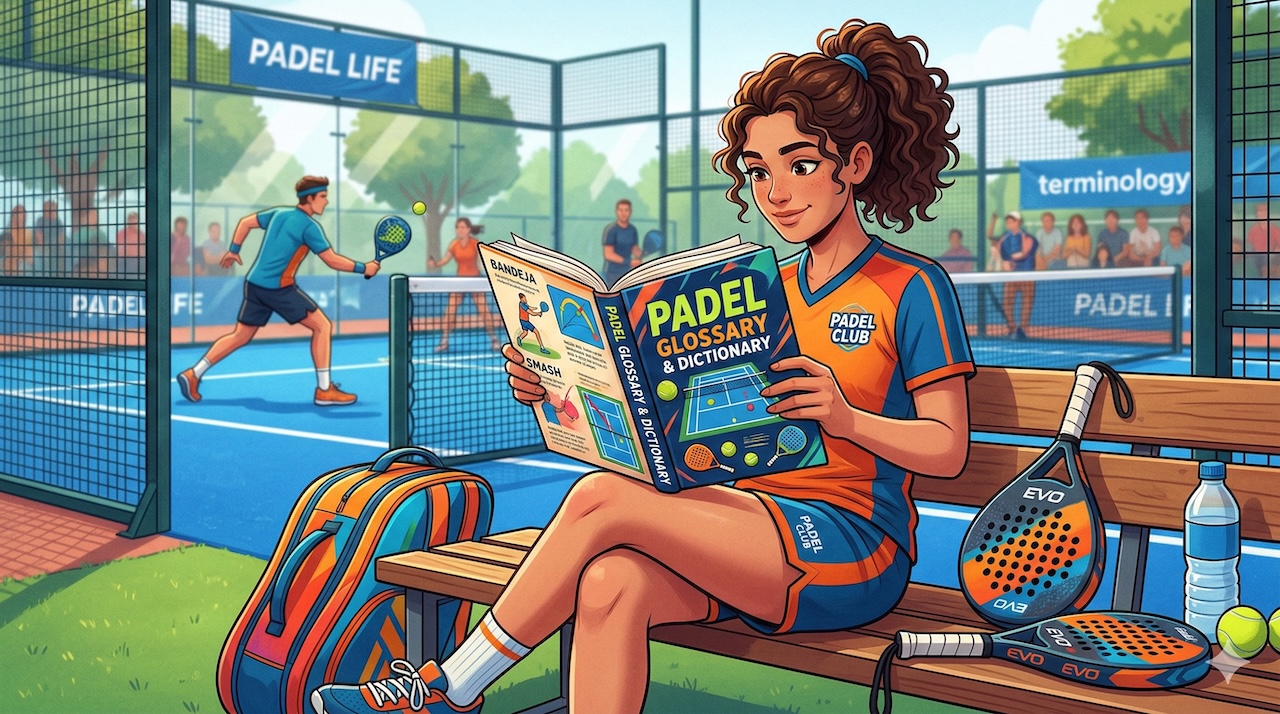
Whether you’re new to padel or advancing your game, understanding the terminology is crucial. This comprehensive glossary covers 50+ essential padel terms — from basic court elements to advanced shots and strategies.
Why Padel Terminology Matters
Padel has its own unique vocabulary, blending Spanish origins with tennis influences. Knowing these terms helps you:
- Communicate better with partners and opponents
- Understand coaching and instructional content
- Follow professional matches with deeper insight
- Integrate into the padel community worldwide
Many terms come from Spanish (padel’s birthplace), but English equivalents exist for most. This glossary covers both.
Court & Equipment Terms
The Court
Court (Pista) The playing area for padel, measuring 20m x 10m, enclosed by walls and fencing. See our detailed padel court dimensions guide.
Glass (Cristal) The transparent walls at the back of the court (typically 3-4m high). Unlike fencing, glass is solid and provides predictable ball rebounds.
Fence (Malla/Valla) The metal mesh walls on the sides and above the glass. Balls can pass through fence openings, ending the point.
Service Box (Cuadro de Saque) The rectangular area where serves must land, located diagonally from the server. Divided by the service line into two zones.
Service Line (Línea de Saque) The line 3 meters from the net, parallel to it. The server must stand behind this line when serving.
The T The junction where the service line meets the center service line, forming a T-shape. A strategic target for deep serves.
Center Mark (Marca Central) The small mark at the center of the baseline, indicating where the server should position for serves.
Baseline (Línea de Fondo) The back boundary line of the court, where players typically return serves before advancing to the net.
Equipment
Padel Racket (Pala) The solid-faced racket (no strings) used in padel. Unlike tennis rackets, padel rackets have perforated surfaces and are smaller. See how to choose the right padel racket.
Grip (Empuñadura) The handle of the racket where you hold it. Grips can be replaced with overgrips for comfort and sweat absorption.
Overgrip (Overgrip) A thin wrap placed over the original grip for better feel, moisture absorption, and to maintain grip size as the original wears down.
Padel Ball (Pelota) Similar to a tennis ball but with slightly less pressure, resulting in a slower bounce. Balls lose pressure over time and should be replaced regularly.
Sweet Spot (Punto Dulce) The optimal hitting area on the racket face, typically in the center, where power and control are maximized.
Basic Shots & Techniques
Fundamental Shots
Serve (Saque/Servicio) The shot that starts each point. In padel, you must bounce the ball once and hit it at or below waist height. Unlike tennis, you only get ONE serve attempt. Read our complete padel serve guide.
Forehand (Derecha) A shot hit on your dominant side (right side for right-handers). The most natural and typically most powerful groundstroke.
Backhand (Revés) A shot hit on your non-dominant side. Can be executed with one or two hands on the racket.
Volley (Volea) Hitting the ball before it bounces, typically at the net. A fundamental offensive shot in padel. See volley techniques.
Groundstroke (Golpe de Fondo) Any shot hit after the ball bounces, typically from the back of the court.
Lob (Globo) A high, arcing shot designed to push opponents away from the net or to defend against aggressive net play. Learn when to use the lob.
Smash (Remate) An overhead shot hit downward with power, typically used to finish points. The most aggressive shot in padel. See different types of smashes.
Intermediate & Advanced Shots
Spanish Shot Names (Commonly Used Worldwide)
Bandeja A defensive overhead shot hit with slice, keeping the ball low and placing it deep with control. Less aggressive than a smash, used to maintain net position. Full guide: bandeja technique.
Víbora An aggressive overhead shot with heavy topspin, causing the ball to kick up sharply off the glass after bouncing. Named for the “snake-like” movement. Learn the víbora vs bandeja difference.
Chiquita A soft, low shot hit from below net height, landing at opponents’ feet near the net. Used to neutralize aggressive net players and regain offensive position.
Dejada (Drop Shot) A softly hit shot that barely clears the net and dies quickly, forcing opponents to sprint forward. Most effective when opponents are deep. See drop shot tactics.
Contrapared Hitting the ball into your own back wall first, then over the net. Used when trapped behind the baseline with no direct angle to the net.
Por Tres (Smash Por Tres) An angled smash that bounces in the opponent’s court, hits the side wall, then exits through the back wall opening — an unplayable winner. Read about smash por tres.
Salida de Pared (Wall Shot) Letting the ball hit the back wall after bouncing, then playing it on the rebound. A fundamental defensive skill. Guide: wall shot technique.
Globo de Pared (Wall Lob) A lob that bounces, hits the back glass, and arcs high over opponents at the net. Difficult to return when executed well.
Bajada de Pared (Back Wall Return) Hitting the ball after it rebounds off the back wall. Requires timing and positioning to generate power from this defensive position. See back wall technique.
Gancho An extremely angled shot (usually overhead) that curves sharply toward the side wall, creating difficult geometry for opponents. Learn the gancho shot.
Rulo A shot with heavy sidespin that curves dramatically in flight, often used at the net to create extreme angles. Master the rulo technique.
Passing Shot (Passing) A shot hit past net players, typically down the line or through the middle, forcing them to move or be beaten. Read passing shot strategies.
Scoring & Rules Terms
Game (Juego) A unit of scoring won by the first team/player to reach 4 points (15, 30, 40, game), with a 2-point advantage required.
Set (Set) A unit of play won by the first team to win 6 games with a 2-game advantage, or 7-6 via tiebreak.
Match (Partido) A complete padel contest, typically best of 3 sets.
Deuce (Iguales/40-40) When both teams have 40 points in a game. Also called “iguales” in Spanish.
Advantage (Ventaja) The point after deuce. The team with advantage needs one more point to win the game.
Tiebreak (Tiebreak/Muerte Súbita) A special game played at 6-6 in a set, first to 7 points (with 2-point advantage) wins the set.
Golden Point (Punto de Oro) An increasingly popular scoring variation where at deuce, a single deciding point is played. The receiving team chooses which side to defend. Read about Golden Point rules.
Let (Let) A serve that touches the net but lands in the correct service box. In padel, lets are replayed (no penalty).
Fault (Falta) A serve that misses the service box or violates serving rules. Unlike tennis, you only get ONE serve — a fault loses the point.
Strategy & Positioning Terms
Court Positions
Net Position (Posición de Red) Standing close to the net, typically 2-3 meters away. The dominant offensive position in padel.
Defense Position (Posición de Fondo) Playing from the back of the court, near the baseline. A defensive position used when under pressure.
Right Side (Lado Derecho) Traditionally occupied by the player with the stronger forehand. Covers more court and handles most overheads. Learn about left vs right side roles.
Left Side (Lado Izquierdo) Traditionally occupied by the player with the stronger backhand. Protects the middle and assists with net play.
Attack Formation (Formación de Ataque) Both players at the net, applying maximum pressure to opponents.
Defense Formation (Formación de Defensa) Both players at the baseline, retrieving shots and waiting for opportunities to advance.
Australian Formation (Formación Australiana) A serving formation where the server’s partner stands on the same side as the server (both right or both left), creating confusion and different angles.
Tactical Concepts
Dominate the Net (Dominar la Red) The fundamental strategic principle of padel: the team at the net controls the point and has the highest winning percentage.
Force Errors (Provocar Errores) Playing consistently and using placement to make opponents miss, rather than attempting winners on every shot.
Build the Point (Construir el Punto) Patiently working through multiple shots to create an opening, rather than trying to win immediately.
Change Rhythm (Cambiar el Ritmo) Varying pace and shot selection (lobs, drop shots, hard drives) to disrupt opponents’ timing and comfort.
Player & Game Vocabulary
Doubles (Dobles) The standard format of padel, with two players per team (four total on court). Padel is almost exclusively played in doubles.
Mixed Doubles (Dobles Mixtos) Teams composed of one male and one female player.
Server (Sacador) The player initiating the point with the serve.
Receiver (Restador) The player receiving the serve.
Partner (Pareja/Compañero) Your teammate in doubles play. Communication and chemistry with your partner are critical.
Switch (Cambio) When both players on a team change positions mid-point (left player moves right, right player moves left) to optimize positioning.
Rally (Peloteo) An exchange of shots between teams, continuing until someone wins the point.
Winner (Winner) A shot that wins the point outright without the opponent touching it.
Unforced Error (Error No Forzado) A mistake made without pressure from the opponent (missing an easy shot, hitting the fence, etc.).
Forced Error (Error Forzado) A mistake caused by good opponent play (hitting a tough volley into the net, etc.).
Special Situations & Etiquette
Out (Fuera) A ball landing outside the court boundaries or passing through the fence opening.
In (Dentro/Buena) A ball landing inside the court boundaries.
Let’s Play (Vamos a Jugar) Often called when starting a friendly match or resuming after a dispute.
Good/Nice Shot (Buena/Bien Jugado) Acknowledging a good shot from your opponent or partner — good sportsmanship.
Sorry (Perdón) Said when you accidentally interfere with your partner or make an obvious mistake.
My Fault (Mía) Calling a ball to indicate you’ll play it, preventing confusion with your partner.
Common Spanish Phrases Used in Padel
While English is widely understood, Spanish phrases are common in padel worldwide:
- “Vamos!” = Let’s go! (Encouragement)
- “Bien!” = Good! (Positive feedback)
- “Fuera!” = Out! (Calling a ball out)
- “Tuya!” = Yours! (Telling partner to take the ball)
- “Mía!” = Mine! (Calling the ball)
- “Perdón” = Sorry
- “Suerte” = Good luck
- “Buena suerte” = Good luck (more formal)
Equipment-Related Slang
Dead Ball (Pelota Muerta) A ball that has lost pressure and bounces poorly, should be replaced.
Sweet (Dulce) Describing a shot hit perfectly on the sweet spot — feels effortless.
Frame Shot (Golpe de Marco) Accidentally hitting the ball on the racket’s edge/frame rather than the face, resulting in poor control.
Shank A mishit where the ball flies wildly off target, typically from hitting near the racket’s edge.
How to Use This Glossary
New players: Start with Court & Equipment terms, then Basic Shots. Master these before moving to advanced vocabulary.
Intermediate players: Focus on Spanish shot names (bandeja, víbora, etc.) and Strategy terms to elevate your game understanding.
Advanced players: Use this as a teaching reference when coaching others or as a quick reminder of less common terms.
Pro tip: Bookmark this page! It’s designed as an ongoing reference you can return to whenever you encounter unfamiliar padel terminology.
Keep Learning
Understanding padel vocabulary is just the beginning. To truly improve your game:
- Practice the shots described in this glossary
- Watch professional matches and listen for these terms
- Communicate with your partner using precise vocabulary
- Ask questions when you hear unfamiliar terms at your club
The padel community is welcoming — don’t hesitate to ask fellow players to explain terms you don’t know.
Related Guides
Want to dive deeper into specific topics covered in this glossary?
- Complete Padel Rules Guide
- How to Serve in Padel
- Padel Court Dimensions Explained
- Padel for Beginners: Complete Guide
- Complete Arsenal of Padel Shots
Track your progress and build your padel vocabulary with Padellog — the free app for recording matches, tracking stats, and improving your game.
Quick Reference Summary
Most Essential Terms (Start Here):
- Pala (racket)
- Saque (serve)
- Volea (volley)
- Remate (smash)
- Globo (lob)
- Bandeja (defensive overhead)
- Víbora (topspin overhead)
- Red (net position — where you want to be!)
Remember: Padel is about dominating the net, patience, and teamwork. Master the vocabulary, and you’ll understand the game at a deeper level — and enjoy it even more!